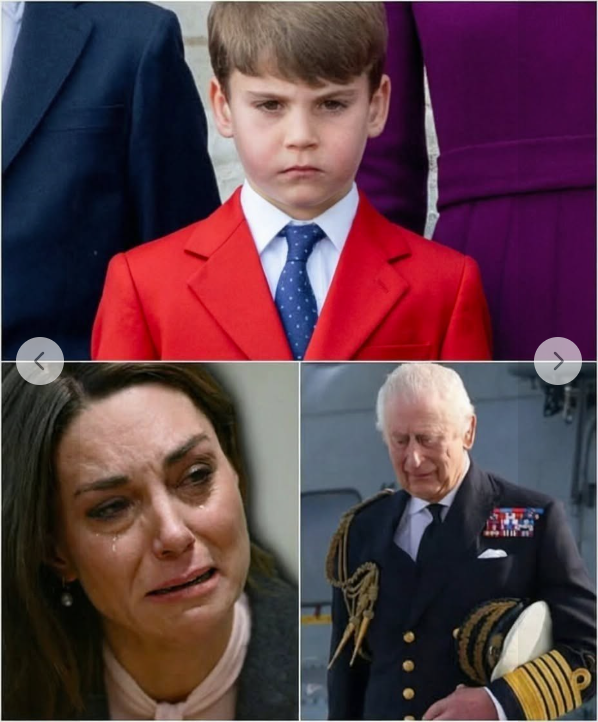
A dramatic claim circulating online says that Catherine, Princess of Wales, has finally broken a supposed 10-year silence about her youngest son, Prince Louis. According to the viral wording, Kate was allegedly “voice trembling” when she confirmed a devastating secret, while courtiers supposedly rushed around and palace bells sounded.
The post then builds toward an unfinished quotation:
The wording is designed to create suspense and encourage readers to keep clicking. But there is a major problem: there is no credible evidence that this dramatic revelation happened.
A review of current official royal records and reputable reporting does not support the claim that Kate Middleton has publicly announced a hidden or devastating truth about Prince Louis. The official Royal Family website continues to identify Louis as the third child of the Prince and Princess of Wales, born on April 23, 2018.
As of September 17, 2026, the Royal Family's official news and press-release pages also do not show an announcement matching the viral story.
So what is actually known about Prince Louis, and why do stories like this spread so quickly?
The headline accompanying the image makes several extraordinary suggestions.
None of those details should automatically be accepted simply because they appear in a polished social-media post.
The most important question is straightforward:
Where is the original announcement?
A genuine revelation involving a member of the immediate British royal family—particularly one involving the Princess of Wales and her eight-year-old son—would normally leave a substantial public record.
There would be an identifiable speech, interview, palace statement, video, transcript, or reporting from major news organizations.
Instead, the viral wording provides none of these things.
The official Royal Family website provides basic biographical information about Prince Louis.
According to the palace's official profile, Louis was born at 11:01 a.m. on April 23, 2018, at St Mary's Hospital in Paddington, London. He weighed 8 pounds 7 ounces at birth.
He is the third child of William and Catherine, the Prince and Princess of Wales, and is fourth in line to the British throne.
The official biography also records that his parents announced his name as Louis Arthur Charles on April 27, 2018, and that he was baptized on July 9, 2018.
That information is important because it provides a reliable baseline against which sensational online claims can be examined.
There is no reference in the official biography to a mysterious revelation, hidden identity, secret medical condition, family scandal, or other “devastating truth.”
That does not mean every private detail of a royal child's life is publicly known. It simply means there is no official evidence supporting the dramatic story being circulated.
Perhaps the biggest warning sign in the headline is the claim that Kate has supposedly maintained a secret for 10 years.
In September 2026, he is eight years old—not 10.
That makes the phrase “after 10 years of secrecy” immediately questionable when it is presented as being specifically about Louis himself.
There is another possibility: the number may simply have been inserted into the headline to make the story sound older and more mysterious than it actually is.
This is a common feature of viral clickbait.
A phrase such as “after years of secrecy” sounds intriguing.
“After 10 years of secrecy” sounds even more dramatic.
But a dramatic number is not evidence.
The official royal biography confirms Louis's birth date, making it easy to establish that he cannot personally have been the subject of a 10-year-long secret beginning before his birth.
There is no credible evidence located in the current official royal record that Kate made the supposed statement:
The wording itself should also raise questions.
A genuine quotation from a public appearance should normally have a source.
Was it during a televised interview?
Was it part of a recorded speech?
Was it released by Kensington Palace?
Was it written in an official statement?
The viral post provides none of that information.
Without an original source, the quotation cannot reasonably be treated as an authentic statement by Kate.
The documented record presents a very different picture from the dramatic headline.
Prince Louis has continued to appear publicly with his parents and siblings at selected royal events.
In April 2026, Reuters documented Prince Louis attending the Easter Matins service at St George's Chapel in Windsor alongside Prince William, Princess Kate, Prince George and Princess Charlotte.
In June, Reuters photographs documented the Prince and Princess of Wales arriving at the Trooping the Colour celebrations with George, Charlotte and Louis.
And in August 2026, William and Kate took all three children to the Commonwealth Games in Glasgow.
ABC News reported that George, Charlotte and Louis attended the event with their parents, participating in public interactions and meeting athletes and volunteers.
These are documented public appearances.
They do not resemble a family preparing to announce the kind of extraordinary revelation suggested by the viral post.
Another useful piece of evidence comes from coverage of Louis's eighth birthday.
People published a retrospective in April 2026 covering photographs and notable moments from Louis's childhood. The article described him as the youngest child of William and Kate and reviewed several of his public appearances over the years.
The coverage focused on ordinary milestones associated with a young member of the royal family: birthdays, public ceremonies, family appearances and childhood photographs.
Again, there is no indication of a secret revelation resembling the one described by the viral headline.
The image attached to the claim shows Prince Louis in a red jacket, alongside images of Kate appearing emotional and King Charles III.
But photographs can easily be used to create a narrative that the original images never established.
A picture of someone looking sad does not prove why they are sad.
A picture of a child looking serious does not establish that something terrible has happened to him.
And a picture of King Charles looking emotional does not establish that he has reacted to a particular announcement.
This is especially important with celebrity and royal content because photographs from completely different occasions can be combined into one graphic.
The resulting collage can look like a single event even when the individual photographs were taken at different times and places.
Therefore, the image should not be treated as proof of the accompanying headline.
The image of Kate used in the post is particularly important.
But an emotional expression alone cannot establish what caused it.
A photograph is a moment in time. Without reliable information about when and where it was taken, it cannot prove that the person was reacting to the alleged event described in a social-media caption.
This is one of the most common problems with viral celebrity stories.
A genuine photograph is sometimes paired with a false explanation.
The Royal Family's official website maintains a Court Circular documenting royal engagements.
This provides a useful way to check whether a major public event involving senior royals has occurred.
The current Court Circular records numerous recent engagements by the Prince and Princess of Wales. For example, on September 11, 2026, the Princess of Wales visited the Royal Marsden Hospital, while the Prince of Wales undertook another engagement.
The record also shows William and Kate carrying out a joint engagement on September 10, 2026, when they launched a suicide-prevention toolkit for people in sport.
The official Royal Diary likewise lists upcoming engagements for members of the royal family.
There is no corresponding official entry announcing a dramatic public revelation by Kate about Prince Louis.
That does not prove that every private conversation in the royal household is known to the public.
But it does make the extraordinary viral story unsupported.
Prince Louis is fourth in line to the throne.
That position has remained publicly established since his birth.
The official Royal Family website explicitly states that Louis is fourth in line to the throne.
His position is also historically significant because the succession rules were changed so that a younger son no longer automatically outranks an older daughter.
Consequently, Princess Charlotte remains ahead of Louis in the line of succession despite being older than him.
These are established constitutional facts—not secrets.
There is a genuine reason why information about royal children can sometimes appear limited.
William and Kate have repeatedly tried to balance their children's public responsibilities with their privacy.
That means the public does not receive a continuous stream of information about George, Charlotte and Louis.
Official photographs are sometimes released.
That limited access can create an information vacuum.
And information vacuums are fertile ground for speculation.
When people know that a famous family protects its children's privacy, some online publishers can exploit that uncertainty by suggesting that something enormous is being hidden.
But privacy should not be confused with evidence of a secret scandal.
There is, in fact, a significant and well-documented story involving Kate herself—but it is not about a secret concerning Prince Louis.
In 2024, Kate announced that she was undergoing cancer treatment.
Reuters reported in 2026 that she had subsequently said she was in remission and had gradually increased her public engagements.
Her health journey understandably generated enormous public interest.
She subsequently returned to more public duties, including a visit to Italy in May 2026, her first overseas trip since her illness. Reuters reported that the trip focused on early childhood development and the Reggio Emilia approach.
That real history may help explain why emotional photographs of Kate can attract attention.
However, her documented health history should not be turned into unsupported claims about her children.
One of the clearest genuine themes in Kate's public work is early childhood development.
She established The Royal Foundation Centre for Early Childhood in 2021.
Her public work has focused heavily on children's social and emotional development, relationships and the environments in which children grow up.
Reuters reported in 2026 that her work continued to emphasize children's social and emotional wellbeing.
This is an important distinction.
There is a substantial amount of genuine information available about Kate's interest in children's wellbeing.
But a legitimate public interest in childhood development does not support a claim that she has secretly been preparing to reveal a devastating truth about Louis.
The phrase “courtiers scrambled” is another classic example of dramatic storytelling.
It creates an impression that something extraordinary has happened inside the palace.
But the wording does not identify:
Without those details, the phrase functions primarily as atmosphere.
It makes the story feel urgent without providing evidence.
The same applies to the statement that “palace bells sounded.”
That wording is designed to create a cinematic image of Britain reacting to a shocking royal announcement.
But no credible evidence has been found establishing such an event in connection with Prince Louis.
Another phrase worth examining is “the nation froze.”
This is not a factual measurement.
A responsible news report would describe what happened:
“Buckingham Palace issued a statement…”
“Major broadcasters interrupted programming…”
Instead, “the nation froze” gives the reader an emotional reaction before they even know what supposedly happened.
This is a powerful clickbait technique.
The reader is encouraged to imagine a historic event without being shown evidence that the event occurred.
Perhaps the most important question for anyone encountering this story is:
If the Princess of Wales had publicly revealed a major secret concerning her youngest son, a credible report should identify the source.
If none of these exists, the claim should be treated with caution.
Screenshots and social-media graphics are not substitutes for primary sources.
Current royal coverage in September 2026 has included developments such as Prince George beginning his education at Eton College.
The Associated Press reported that Kensington Palace confirmed George would begin attending Eton in the fall. His younger siblings, Charlotte and Louis, had previously attended Lambrook School with him.
Recent coverage has also continued to document William and Kate's public activities and the family's appearances.
The official royal website's current news section lists recent royal engagements, including events involving the King, Queen and other members of the family.
None of this supports the alleged revelation described in the viral post.
No outsider can claim to know every private conversation within a family.
The fact that no public evidence exists does not establish that the royal family has no private matters.
But that is very different from saying that a specific sensational claim is true.
A responsible fact-check must distinguish between:
“We cannot know everything about their private lives.”
“This viral story has been confirmed.”
The first statement is obvious.
The second is not supported by the available evidence.
There is another reason this story deserves particular caution.
Even though he is a member of the British royal family and appears at selected public events, he remains a young person.
Speculation about children can have consequences beyond ordinary celebrity gossip.
Claims involving secret illnesses, hidden identities, family revelations or supposed scandals can spread quickly and remain online long after they have been disproven.
That makes responsible reporting particularly important.
Readers should avoid turning an unverified headline into a statement of fact.
No credible source identified in the current review confirms such a revelation.
No authenticated transcript or official recording has been identified.
There is no reliable evidence documenting such an event.
No official royal record or reputable report confirms this.
The official Royal Family website says he was born on April 23, 2018, making him eight in 2026.
This is stated by the official Royal Family website.
Reuters and ABC News documented family appearances including Easter and the Commonwealth Games.
The post is written in a way that encourages immediate emotional reaction.
secrecy + a child + a famous mother + tears + palace drama + an unfinished quotation.
That combination is extremely effective at attracting clicks.
But strong emotional language should increase the reader's desire to verify the story—not decrease it.
If the answer is simply “Facebook,” “a viral page,” or “social media,” that is not enough.
Look for an identifiable source.
When a headline makes an extraordinary claim, use a simple five-step process.
Ask exactly what supposedly happened.
In this case: Did Kate publicly reveal a secret about Louis?
Search for the supposed speech, interview, video or palace announcement.
A photograph from years ago can easily be presented as if it happened yesterday.
Look at official royal communications and established news organizations.
A photograph can be authentic while its caption is false.
The viral story claiming that Kate Middleton has finally revealed a devastating secret about Prince Louis after “10 years of secrecy” is not supported by credible evidence.
The official Royal Family website confirms the basic facts about Louis: he was born on April 23, 2018, is the third child of William and Catherine, and is fourth in line to the throne.
Current official royal records show William and Kate continuing their public duties, while recent reputable reporting documents Louis appearing with his family at public events in 2026.
There is no verified evidence in the sources reviewed that Kate made the dramatic statement described in the viral post, nor that palace officials scrambled or that a major announcement about Louis occurred.
The emotional photographs in the collage do not establish the story either. Images can be genuine while the narrative attached to them is misleading.
For now, the responsible conclusion is simple:
There is no verified “devastating truth” about Prince Louis matching the viral headline. The claim should not be presented as established fact.
The real story is much less dramatic—but also much more reliable: Prince Louis is an eight-year-old member of the British royal family who continues to appear occasionally with his parents and siblings while his family maintains a degree of privacy around his childhood.
And when a headline promises a shocking royal confession but cannot provide an original recording, official statement, date, location or credible reporting, readers should pause before clicking share.
Fact-check status: UNVERIFIED / UNSUPPORTED.


0 comments:
Post a Comment