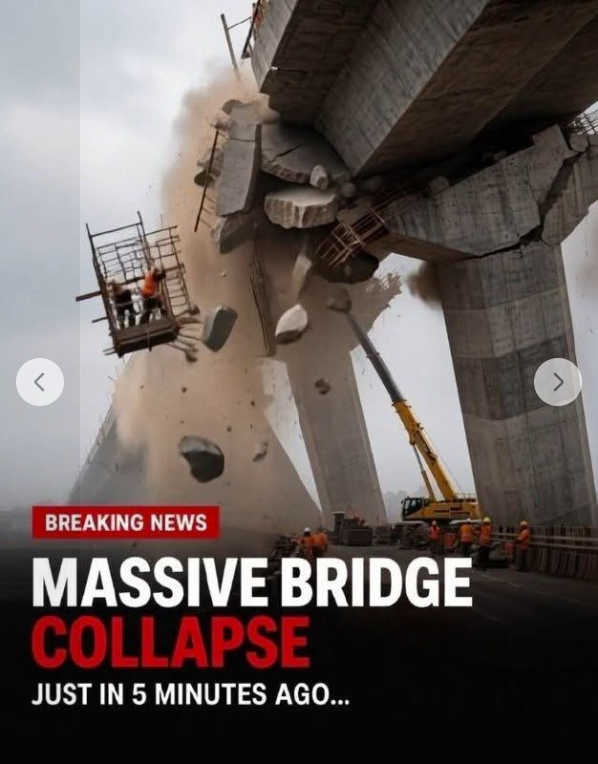
A dramatic headline circulating online reads:
“BREAKING NEWS: Just in 5 minut ago… See more.”
The wording is designed to create a sense of urgency. It suggests that something extraordinary has happened only moments ago and encourages readers to click before the details are revealed.
But in this case, there is an important problem with treating the headline as a genuine breaking-news alert.
The phrase has been reused by several low-quality websites during 2026, and at least one version attaches it to a dramatic story about a commercial truck striking an overpass in Richmond, British Columbia. Yet the underlying incident described in that material actually happened on February 10, 2023, more than three years before some of the 2026 posts carrying the supposedly immediate headline.
Official and local records confirm that a commercial vehicle collided with the Cambie Road overpass while traveling southbound on Knight Street in Richmond. The truck was towing a dump trailer whose bed was raised, causing it to strike the overpass. The vehicle and trailer became separated, southbound lanes were closed, and engineers assessed the structures. Importantly, no injuries were reported.
So what looks like a fresh emergency may actually be an old event being repackaged as new.
The collision happened on the morning of Friday, February 10, 2023.
According to Richmond RCMP and local reporting, police responded to Knight Street in Richmond after receiving reports of a commercial vehicle collision near the Cambie Road overpass. The truck was traveling southbound when its raised dump trailer failed to clear the overhead structure.
The trailer remained lodged beneath the overpass, while the commercial vehicle was separated from the trailer and came to rest some distance away. Photographs and video from the scene showed the trailer pushed up against the structure, creating an immediately visible hazard for motorists.
Police closed the southbound side of Knight Street while the situation was investigated and the affected infrastructure was examined.
It was a dramatic-looking collision.
But there was one critical piece of information that made the event much less catastrophic than the images might have suggested:
That fact can easily disappear when an old news story is rewritten with sensational language.
The phrase “just in 5 minutes ago” is a classic social-media attention device.
It creates an immediate emotional response.
A reader may assume that television networks are currently interrupting regular programming, emergency agencies have issued a new warning, or a major disaster is unfolding in real time.
But the headline itself gives almost no information.
There is no description of what occurred.
And most importantly, there is no indication that the event is actually happening now.
A search of the phrase shows that it has appeared repeatedly on websites with very different articles attached to it. One August 2026 page using the same wording presented the Richmond truck collision as its subject, while other sites have published nearly identical “breaking news” pages containing generic emergency language.
This illustrates why the words “breaking news” should never be treated as proof that a story is breaking.
The date of the underlying event matters far more.
The details of the 2023 collision help explain why the incident attracted attention.
Richmond RCMP determined that the commercial vehicle was towing a dump trailer with the bed in a raised or vertical position. The elevated trailer did not have enough clearance to pass underneath the overpass.
The trailer struck the structure with enough force to become lodged underneath it.
The commercial vehicle itself was then found a short distance away after becoming separated from the trailer.
Local reporting described the incident as causing a major traffic disruption during the morning commute.
Drivers were redirected, and the closure lasted for many hours while authorities and engineering officials examined the affected infrastructure. CityNews reported that the road remained closed for more than 12 hours before it reopened.
For commuters, the practical consequences were significant.
Knight Street is an important transportation route through Richmond and the surrounding Lower Mainland. A major southbound closure during the morning rush can affect traffic far beyond the immediate collision site.
Yet the incident could have been much worse.
There were no reported injuries.
After a heavy commercial vehicle strikes an overpass, authorities cannot simply remove the truck and immediately allow normal traffic to resume.
The first question is structural safety.
A collision can damage concrete, steel, barriers, sidewalks and other components that may not appear unstable from a distance.
That is why engineering inspections were ordered after the Richmond collision.
Richmond city records later documented that a structural engineer was retained to assess the damage caused by the February 10, 2023 collision. The assessment found that the Cambie Road overpass was safe to remain open to traffic, although damage had occurred to portions of the sidewalk and the northernmost vehicle lane.
That later municipal record is especially useful because it provides information that was not available in the first hours after the collision.
Immediately following an accident, officials often do not know whether an affected structure is safe.
They have to consider possible hidden damage.
And they have to make decisions based on engineering evidence rather than appearances.
A common mistake in reporting transportation incidents is to assume that an event was unimportant simply because nobody was hurt.
The collision caused the closure of southbound Knight Street and disrupted the morning commute. Traffic was diverted to other roads, producing significant delays.
For people traveling to work, school, medical appointments and other commitments, a major road closure can have consequences for hours.
Emergency crews also have to work in a controlled environment.
Removing a damaged commercial vehicle from beneath an overpass is not a routine roadside tow.
Officials must make sure the structure remains stable.
Traffic control must prevent additional collisions.
Engineering personnel must assess the roadway.
And investigators may need to preserve evidence.
The crash was not treated simply as a mechanical accident.
Richmond RCMP opened an investigation and said the driver was uncooperative with investigators. Police also asked members of the public who had information or dash-camera footage to come forward.
The police statement did not establish criminal responsibility simply because the driver was described as uncooperative.
That detail is worth emphasizing because online retellings can easily turn a preliminary investigative statement into an accusation.
A person who is uncooperative is not automatically guilty of an offence.
Investigators still have to determine what happened and whether any laws were broken.
The police investigation therefore represented a process of fact-finding rather than a final judgment.
The request for dashcam footage is another interesting part of the story.
Modern vehicles and smartphones have made eyewitness evidence increasingly useful in traffic investigations.
A driver passing through the area might have captured the truck shortly before the collision.
Video could potentially show whether the trailer was raised before the truck approached the bridge.
It could also help establish timing, traffic conditions and vehicle movements.
Police frequently ask the public for such footage after unusual roadway incidents because witnesses may possess information that investigators do not initially have.
In a busy metropolitan area, several independent cameras may capture the same event from different angles.
That information can help investigators reconstruct what happened much more accurately.
The Richmond case also illustrates a familiar hazard involving commercial vehicles.
Dump trailers are designed to raise their beds during unloading.
That function is useful at construction sites, waste facilities and other locations where material must be discharged.
But the elevated bed dramatically changes the vehicle's height.
A truck that is safely below an overhead clearance when the trailer is lowered can become dangerously tall when the bed is raised.
Overpasses, bridges, signs and other overhead structures therefore present obvious hazards.
The Richmond collision demonstrated what can happen when a raised trailer enters an area without adequate clearance.
Local news organizations and transportation officials have documented numerous examples of commercial vehicles striking bridges and overpasses in British Columbia.
Global News reported that the Richmond collision occurred amid a broader series of overpass strikes involving trucks in the region.
When a commercial truck hits an overpass, the damaged vehicle is only one part of the story.
The infrastructure itself can require repairs.
Traffic may have to be diverted.
Engineers may have to be brought in.
Crews may have to remove debris or damaged structures.
Transportation authorities may need to inspect surrounding roads.
Businesses can experience delays because employees and deliveries are affected.
Drivers may spend hours sitting in traffic or searching for alternate routes.
And public agencies can face substantial repair costs.
The Richmond incident eventually required engineering work and repairs to portions of the affected overpass infrastructure. The City of Richmond's later report stated that damaged infrastructure would need to be removed and replaced as part of the permanent repair.
In other words, an accident lasting only seconds can create weeks or months of logistical consequences.
One reason these stories continue circulating is the power of photographs.
A picture of a dump trailer wedged against an overpass is visually striking.
A person seeing that image without the date can reasonably assume that the accident has just happened.
That is exactly why images should be checked alongside the text.
But the claim that it happened “five minutes ago” can still be false.
This is an important distinction in the digital-news environment.
Misinformation does not always require a fabricated photograph.
Sometimes all it takes is an authentic photograph attached to the wrong date.
The underlying Richmond collision happened on February 10, 2023. Richmond RCMP reporting, local news coverage and subsequent city documents all support that date.
Yet the same story has subsequently appeared on websites in 2026 under headlines claiming that it had just happened.
That change transforms the meaning of the event.
A 2023 traffic incident is historical reporting.
A collision occurring five minutes ago would be a live emergency.
Those are completely different things.
Readers deserve to know which one they are seeing.
Another point that can become distorted in dramatic retellings concerns the bridge itself.
The impact was serious enough to require an engineering assessment.
But later municipal documentation stated that the structural engineer determined the Cambie Road overpass was safe to remain open to the traveling public.
Damage was still present, particularly around parts of the sidewalk and northernmost vehicle lane, and repair work was undertaken.
Saying that a bridge was hit is accurate.
Saying that it was at risk of imminent collapse would go beyond the evidence cited in the municipal record.
Sensational headlines sometimes blur those differences by using phrases such as “massive destruction,” “shattering the bridge” or “catastrophic collapse.”
The actual record is more specific.
There was infrastructure damage.
Engineers inspected the structure.
The bridge was ultimately assessed as safe for continued use, subject to repairs to damaged portions.
The absence of injuries is perhaps the most significant aspect of the story.
The collision occurred during the morning commute, when roads in metropolitan areas can be busy.
A large commercial vehicle striking an overpass could potentially have produced a much more serious chain of events.
Instead, authorities closed the affected lanes and concentrated on securing the scene and assessing the infrastructure.
Emergency response does not always produce dramatic television images.
Often, effective response looks like roadblocks, engineering assessments, traffic diversions and methodical investigation.
That quieter work can be exactly what prevents a secondary disaster.
The phrase “BREAKING NEWS: Just in 5 minut ago…” does not tell readers anything about:
whether the bridge was damaged,
or what investigators concluded.
Those are the details that actually allow someone to understand an event.
The headline's only clear purpose is to create urgency.
That is why readers should avoid sharing it as a current emergency without checking the underlying story.
The fact that this incident happened in 2023 does not make it uninteresting.
There are useful lessons in the event.
It demonstrates the risks associated with raised dump trailers.
It highlights the importance of overhead-clearance awareness for commercial drivers.
It shows why road closures can be necessary even when there are no injuries.
It illustrates how engineers assess infrastructure after a collision.
And it demonstrates how an incident can have significant effects on a community even when the immediate casualty count is zero.
The problem is not that the story has been retold.
The problem is presenting an old story as though it happened moments ago.
Truck strikes involving bridges and signs are a continuing transportation concern in many areas.
Overpasses are built with specified clearance heights.
Commercial vehicles operate within their own dimensional limits.
Safety depends on both the infrastructure and drivers following appropriate procedures.
When a trailer is raised in a location where it should be lowered, the risk becomes obvious.
Modern transportation systems also increasingly use warning signs and clearance indicators to alert drivers of potential hazards.
However, even the best infrastructure cannot eliminate every human error.
That is why driver awareness remains essential.
A momentary failure to recognize that a dump bed is still elevated can result in significant damage.
The Richmond collision illustrates an important principle about accidents.
A fortunate outcome does not mean an event should be ignored.
But the collision still caused a major traffic disruption and damaged infrastructure.
A useful safety system should examine both outcomes.
The absence of casualties tells us the immediate human consequences were limited.
The infrastructure damage tells us that something still went wrong.
Investigators, transportation authorities and engineers can use incidents like this to consider how similar collisions might be prevented.
That can include reviewing warning systems, driver education, roadway design and commercial-vehicle procedures.
A few simple checks can reveal whether an urgent headline is really current.
Check whether police, emergency services or government agencies have issued a statement.
Compare the headline with established local news organizations.
And pay attention to whether the article itself describes the event as occurring years earlier.
These steps are particularly important when a headline contains phrases such as “just five minutes ago,” “breaking,” “shocking,” or “you won't believe what happened.”
Those phrases are marketing language.
The Richmond overpass collision may have been visually dramatic, but the verified facts tell a more measured story.
A commercial vehicle towing a raised dump trailer struck the Cambie Road overpass on Knight Street in Richmond on February 10, 2023. The trailer became lodged under the structure, the truck and trailer separated, and police closed the southbound lanes while the situation was investigated. No injuries were reported.
Engineers later assessed the overpass and determined that it was safe to remain open, although portions of the structure and roadway required repair.
Those facts are compelling enough without pretending the collision happened “five minutes ago.”
The headline “BREAKING NEWS: Just in 5 minut ago… See more” creates an impression of a fresh emergency, but the version currently circulating online appears to recycle an old Richmond, British Columbia, traffic incident.
The underlying collision took place on February 10, 2023, when a commercial vehicle carrying a raised dump trailer struck the Cambie Road overpass on Knight Street. The impact separated the vehicle from its trailer, caused major traffic disruption and prompted an engineering assessment of the affected infrastructure.
Most importantly, authorities reported no injuries.
Later city documentation confirmed that engineers found the overpass safe to remain open, although damaged sections required repair.
The real story is therefore not a mysterious disaster that suddenly happened five minutes ago.
It is a documented transportation accident from 2023 that continues to be republished under sensational headlines.
In an age when a photograph and a few urgent words can make an old event appear brand new, checking the date and original source is one of the simplest ways to separate genuine breaking news from recycled content.
Sometimes the most important fact in a viral story is not what the headline claims happened moments ago.
It is when it actually happened.


0 comments:
Post a Comment