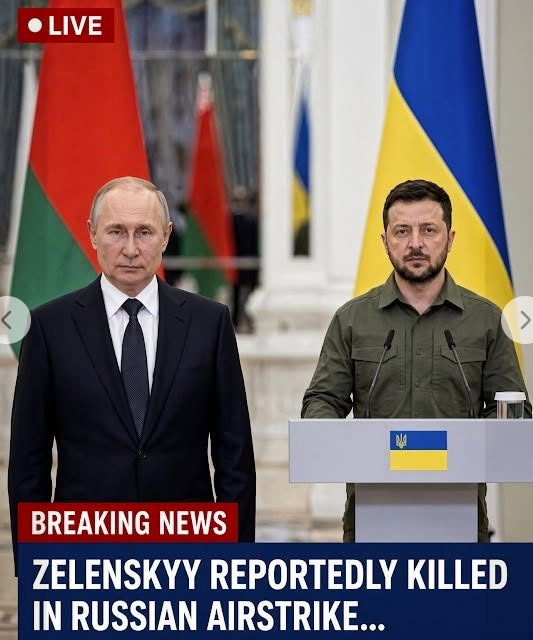
A dramatic image circulating online claims that Ukrainian President Volodymyr Zelenskyy has been killed in a Russian airstrike.
The headline shown in the image is unmistakable:
“BREAKING NEWS!! ZELENSKYY REPORTEDLY KILLED IN RUSSIAN AIRSTRIKE.”
Because the claim concerns the death of a sitting head of state during an ongoing war, it is the kind of headline that can spread extremely quickly on social media. But there is an important problem: current credible reporting does not support the claim that Zelenskyy has been killed.
In fact, reporting from September 17, 2026 provides evidence pointing in the opposite direction.
This article examines what actually happened, where the viral claim may have come from, what is known about the latest Russian attacks, and why dramatic “breaking news” images like this should be treated carefully.
The image presents a photograph of Vladimir Putin and Volodymyr Zelenskyy alongside a large “BREAKING NEWS” banner.
At the bottom, the image states:
“ZELENSKYY REPORTEDLY KILLED IN RUSSIAN AIRSTRIKE…”
However, the image itself does not provide a credible news organization, official statement, military source, government announcement, or identifiable journalist who made the allegation.
A claim as significant as the death of a national leader would normally generate immediate reporting from numerous independent organizations. It would also be expected to trigger official statements from Ukraine, Russia, allied governments and major international news agencies.
As of September 17, 2026, the available reporting does not show such a development.
Instead, multiple reports published that same day describe Zelenskyy carrying out presidential duties and making public statements.
Verdict: False / unsupported by credible evidence.
There was a major Russian missile-and-drone attack against Ukraine on September 17.
But credible reports about that attack do not report Zelenskyy's death.
The Associated Press reported that Russian missiles and drones targeted Kyiv and surrounding regions, injuring at least 19 people, including children. The report also quoted Zelenskyy discussing Ukrainian strikes against Russian targets.
Reuters likewise reported on the Russian attacks against Ukrainian cities on September 17. Its coverage described damage and casualties but did not report the death of Ukraine's president.
More importantly, reporting published during the same day records Zelenskyy actively participating in government affairs.
Ukrinform reported that Zelenskyy met with a Slovenian government delegation in Kyiv on September 17 to discuss defense cooperation, Ukraine's future in Europe and ongoing Russian attacks.
That is fundamentally inconsistent with the viral claim that he had already been killed.
The misleading headline appears to have taken place against the backdrop of a real and serious Russian air attack.
Russia launched a major overnight missile-and-drone offensive against Kyiv and other Ukrainian regions.
According to Ukrainian authorities cited by the Associated Press, the attacks injured at least 19 people, including two children. Ukraine's air force said it destroyed or suppressed 131 Russian aerial targets during the overnight attack.
The affected areas included Kyiv, Odesa and Zaporizhzhia.
Residential and commercial buildings were damaged.
Infrastructure was also affected.
The attacks therefore were real.
What is not established is the dramatic claim that Zelenskyy was killed.
This distinction is extremely important when reading viral posts about an active war.
A real attack can be used as the background for a completely false headline.
One of the strongest pieces of evidence against the viral death claim is that reporting from September 17 describes Zelenskyy participating in official government activity.
According to Ukrinform, Zelenskyy met with Slovenian Foreign and European Affairs Minister Tone Kajzer, Slovenian Defense Minister Valentin Hajdinjak and representatives of Slovenian companies.
The discussion included a proposed “Drone Deal,” defense projects and Ukraine's relationship with Europe.
Another report said Zelenskyy discussed the war and regional security with the Slovenian delegation.
These are not reports describing a president who has disappeared following a fatal attack.
They are reports describing an active head of state.
The Ukrainian president was also commenting publicly on developments connected to the war.
Reports on September 17 said Zelenskyy described Ukrainian strikes against targets inside Russia, including an oil refinery in Yaroslavl and a military airfield in the Rostov region.
According to the Associated Press, Zelenskyy said Ukrainian forces had conducted overnight operations against Russian targets.
He also described damage to Russian military aircraft and helicopters.
These statements were part of the rapidly developing military situation between Russia and Ukraine.
Again, this is important context.
The real story was already dramatic enough.
There was no need to add an unverified claim about the Ukrainian president being killed.
This is one of the biggest problems with misinformation during wartime.
A social-media post can combine:
The result can look like a legitimate news report.
But each element must be checked independently.
Real: Russia launched a major missile-and-drone attack against Ukraine.
Real: Kyiv and other Ukrainian regions suffered damage.
Real: Zelenskyy was publicly discussing the war.
Not supported: Zelenskyy was killed in the attack.
That final claim is the critical difference.
The photograph used in the viral graphic shows Putin and Zelenskyy together.
But a photograph does not establish what happened on the date of a viral post.
Old photographs are frequently reused in social-media graphics.
A picture can be completely authentic while the caption attached to it is false.
This is particularly common with political content.
The image may show something that genuinely happened years earlier, while the text claims something supposedly happened today.
That means readers should never treat the presence of a recognizable photograph as evidence that the accompanying headline is accurate.
The word “reportedly” can make a headline appear cautious.
But it does not automatically make an allegation credible.
without naming who reported it.
That leaves readers unable to determine:
In serious journalism, particularly when reporting the death of a national leader, sourcing is essential.
A credible report would normally identify where the information came from.
The viral graphic does not provide that verification.
False death announcements are among the most powerful forms of misinformation because they trigger an immediate emotional reaction.
They may immediately send it to friends.
Others may repost it before checking.
Some users may only read the large headline without looking for a source.
And once thousands of people repeat the same statement, the claim can begin to look credible simply because it is widespread.
But popularity is not verification.
A false story can receive millions of views.
A true story can initially receive very few.
The number of shares does not establish whether a claim is true.
Although the death claim is unsupported, the underlying war is real and the September 17 attacks were significant.
Reuters reported that Russia carried out a major overnight offensive against Kyiv and other Ukrainian cities using missiles and drones.
The attacks caused injuries and damaged infrastructure across several areas. Poland also scrambled aircraft in response to the regional security situation, although Reuters reported that no Polish airspace violation had been confirmed.
The Associated Press reported that Ukrainian authorities documented damage at multiple locations around Kyiv.
Residential buildings, warehouses and other structures were damaged.
Children were among those injured.
These facts demonstrate why sensational misinformation can be particularly dangerous.
The actual situation is already serious, and false claims can make it much harder for people to understand what is happening.
The September 17 attack also demonstrated the continuing importance of Ukraine's air-defense systems.
Ukraine's air force said it destroyed or suppressed 131 Russian aerial targets during the overnight attack.
The reported attack included different types of missiles, drones and decoys.
That does not mean Ukraine was unaffected.
Buildings were damaged and civilians were injured.
But it demonstrates another problem with simplified viral headlines.
A headline may describe an attack as if one single event produced one dramatic result.
In reality, a major air attack can involve dozens or hundreds of targets, interceptions, impacts, debris fields and different locations.
Understanding those details requires more than a social-media graphic.
Another significant development on September 17 involved Ukraine's Prosecutor General's Office.
Reuters reported that Zelenskyy appointed Anton Kovalskyi as acting prosecutor general after the departure of Ruslan Kravchenko.
That is another documented presidential action occurring on the same day as the viral claim.
It provides additional evidence that Zelenskyy remained active in his presidential role.
Other reporting similarly described the appointment as taking place through a presidential decree.
This is exactly the kind of information that should be checked before believing a viral death announcement.
Another report published September 17 described an interview between Zelenskyy and Japan's NHK.
According to the report, Zelenskyy discussed the war's potential implications for East Asian security and the relationship between Russia, China and North Korea.
This provides yet another contemporaneous indication that Zelenskyy was alive and conducting presidential and diplomatic activities.
Taken together, these reports are incompatible with the claim presented in the viral image.
The September 17 attacks reportedly affected multiple Ukrainian regions.
Kyiv was among the principal areas targeted.
Zaporizhzhia was affected as well.
The Associated Press reported damage to homes, warehouses, infrastructure and other facilities.
The attacks also occurred amid continued military exchanges between Russia and Ukraine.
Ukraine reported strikes against Russian targets, including the Yaroslavl refinery and a military airfield in Rostov.
Russia's Defense Ministry said its forces had targeted industrial, energy and transportation facilities in Ukraine.
As always during wartime, individual claims from the opposing sides can be difficult to independently verify immediately.
That is another reason why headlines announcing extraordinary events require especially strong evidence.
The viral claim appeared during a period in which diplomatic efforts to end the war remained complicated.
The Associated Press reported that negotiations had stalled, with territorial concessions among the central disputes.
Ukraine has also continued seeking security guarantees from international partners.
There have also been disagreements over proposals involving attacks on energy infrastructure.
Reuters reported earlier in September that Zelenskyy had expressed conditional support for an energy ceasefire but said Ukraine needed assurances regarding Russia's commitment to such an arrangement.
That means the military situation remains fluid.
But a complicated diplomatic environment should not be confused with evidence that a political leader has been killed.
Wartime information is particularly difficult to evaluate.
Governments have strategic interests.
Military organizations release selective information.
Social-media users may repost unverified claims.
Old photographs can be presented as new.
Videos can be taken out of context.
And headlines can exaggerate developments.
For that reason, a responsible reader should ask several basic questions whenever a dramatic wartime claim appears.
Is it from an established news organization?
Could an old report be circulating again?
For a president's death, official confirmation would be extraordinarily important.
One anonymous social-media account is not equivalent to multiple independent news agencies.
If credible reports published hours later show the person conducting official business, the original claim deserves extreme skepticism.
Based on the credible information available on September 17, 2026, there is no verified evidence that Volodymyr Zelenskyy was killed in a Russian airstrike.
Instead, contemporary reporting describes him:
Ukrinform reported his meeting with Slovenian officials on September 17.
Reuters reported his appointment of an acting prosecutor general the same day.
Other reporting described his interview with NHK and comments on international security.
These are multiple, contemporaneous indicators that contradict the viral death claim.
At this point, the exact origin of the graphic cannot be established from the image alone.
The image provides no recognizable publication name or verifiable source.
It may have been created specifically as a social-media graphic.
It may have been copied from another account.
It may have originated from a fabricated news page.
Or it may simply be an engagement-oriented graphic designed to encourage people to click.
Without identifying the original publisher and source, it would be inappropriate to claim exactly who created it.
What can be established is that the central allegation is not supported by credible reporting available today.
Because the Russia-Ukraine war continues to develop rapidly, information can change.
A responsible approach is therefore not to assume that every claim is permanently impossible.
Instead, readers should distinguish between:
“There is no evidence right now”
The first statement accurately describes the current evidence.
As of September 17, credible reporting indicates that Zelenskyy remains alive and active.
If a genuine major development involving the Ukrainian president occurred later, it would require confirmation from reliable sources.
Until then, the viral image should not be treated as a legitimate death announcement.
Perhaps the most important lesson from this viral post is that misinformation often works by attaching a false claim to a real event.
There really was a Russian air attack.
There really were missiles and drones over Ukrainian territory.
There really were developments involving Zelenskyy and the war.
But those facts do not establish that Zelenskyy was killed.
The dramatic headline takes a real event and adds a claim that credible evidence does not support.
That is precisely why fact-checking matters.
Claim: “Zelenskyy was killed in a Russian airstrike.”
Assessment: False / unsupported by credible evidence as of September 17, 2026.
What is true: Russia launched a major missile-and-drone attack against Ukraine, including Kyiv and other regions. At least 19 people were reported injured, including children.
What is not supported: There is no credible confirmation that Ukrainian President Volodymyr Zelenskyy was killed.
What the evidence shows instead: Contemporary reports describe Zelenskyy conducting official government business on September 17, including meeting a Slovenian delegation, discussing defense cooperation and responding publicly to the latest attacks.
Reuters also reported a presidential decree appointing an acting prosecutor general on September 17, another indication of Zelenskyy's ongoing official activity.
So while the Russian attacks themselves are a genuine and serious news story, the headline claiming “ZELENSKYY REPORTEDLY KILLED” should not be presented as confirmed news.
For anyone sharing the image on Facebook or elsewhere, a safer and more accurate framing would be:
“Viral Post Claims Zelenskyy Was Killed in Russian Airstrike — Current Reports Do Not Confirm It.”
That wording preserves the newsworthiness of the circulating claim without presenting an unverified death announcement as fact.


0 comments:
Post a Comment