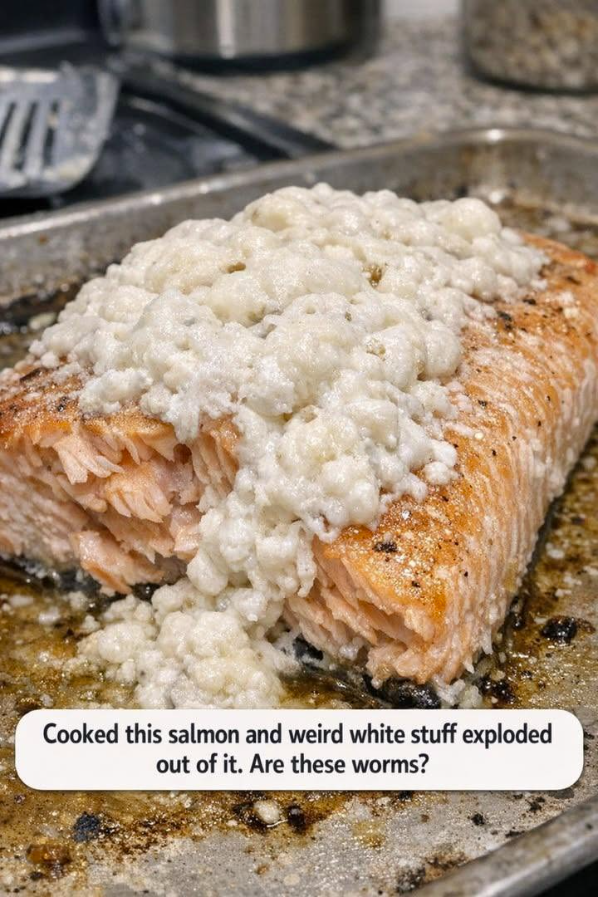
ou put a beautiful piece of salmon in the oven, waited for it to cook, and then noticed something strange.
Instead of seeing only the familiar pink-orange flesh, white, lumpy material has pushed out of the salmon and spread across the surface.
It can look unpleasant.
And if you've never seen it before, it's easy to wonder:
"Are these worms?"
Fortunately, the white stuff shown in situations like this is usually not worms.
In many cases, the white substance is a natural protein called albumin. Albumin is present in fish muscle, and cooking can cause it to coagulate and become visible on the surface.
The amount you see can vary considerably depending on how the salmon was cooked.
So before throwing away your dinner in panic, let's look at what is actually happening inside that salmon, why the white substance appears, whether it is safe to eat, and how you can reduce it the next time you cook salmon.
What Is the Weird White Stuff on Cooked Salmon?
The white material that appears on cooked salmon is commonly albumin.
Albumin is a water-soluble protein naturally found in fish.
When salmon is raw, you generally don't notice much of it because it remains within the muscle tissue.
As the fish heats up, its proteins change structure. This process is called denaturation.
Eventually, some of the proteins coagulate and become visible.
That's when you may see white material emerging from the salmon.
It can look like:
- White beads
- Small white blobs
- Foamy-looking patches
- Thick white streaks
- Creamy or curd-like deposits
The appearance can be surprisingly dramatic, especially when a salmon fillet is cooked at a relatively high temperature.
But the appearance itself does not mean that the fish contains worms.
No, That White Stuff Usually Isn't Worms
The first reaction many people have is understandably:
"What came out of my salmon?"
Parasites can occur in raw or undercooked fish, including some species of salmon, but the white substance that appears as the fish cooks is generally not evidence of a parasite.
The material in the photograph looks consistent with coagulated protein, rather than something that should automatically be identified as worms.
A parasite would have a different appearance and behavior.
For example, people may imagine a worm as a distinct elongated organism. The white material produced during cooking often appears instead as irregular blobs or deposits attached to the fish.
That distinction is important because the strange appearance can make perfectly normal cooked salmon look alarming.
Why Does Albumin Come Out of Salmon?
The answer has a lot to do with heat.
Salmon muscle contains proteins and water.
When the fish is exposed to heat, the proteins begin changing their structure. As the temperature rises, the muscle contracts and some of the proteins and fluids can move toward the surface.
Albumin can then coagulate into a white substance.
You may notice more albumin when the salmon is cooked:
- At a high temperature
- For a long time
- Until it becomes very firm
- In a way that causes substantial moisture loss
In other words, seeing more white material can sometimes be a sign that the salmon has been exposed to relatively intense cooking conditions.
It isn't necessarily a sign that something is wrong with the fish.
Why Does It Look Like It "Exploded" Out of the Salmon?
The image may look dramatic because the white protein has accumulated on top of the fillet.
As salmon heats, its muscle fibers contract.
That contraction can squeeze moisture and proteins toward the surface.
Once the albumin reaches the hotter exterior, it can coagulate and become much more visible.
The result can look almost as if something has burst out of the fish.
This is especially noticeable with thicker salmon fillets.
The larger the piece of fish, the more dramatic the difference between the center and exterior can appear during cooking.
Is the White Stuff Safe to Eat?
Albumin itself is a normal protein in salmon and is not inherently dangerous.
Seeing some white albumin on properly cooked salmon does not automatically mean that the fish has spoiled.
The more important questions are whether the salmon was fresh before cooking, whether it was stored properly, and whether it was cooked safely.
You should not judge fish safety solely by the presence or absence of white material.
A perfectly fresh piece of salmon can produce quite a bit of albumin.
Another piece may produce very little.
Why Does Some Salmon Have More White Stuff Than Others?
You may have noticed that one salmon fillet produces a lot of white material while another barely produces any.
That's normal.
Several factors can influence how much albumin becomes visible.
Cooking temperature
Higher temperatures can cause proteins to coagulate more quickly and can encourage moisture to move out of the muscle.
Cooking time
The longer salmon is exposed to heat, the more its muscle structure changes.
Overcooking can therefore make the white protein more noticeable.
Thickness of the fillet
A thick piece of salmon can cook differently from a thin piece.
The exterior may become significantly hotter while the center is still cooking.
Cooking method
Baking, roasting, grilling and pan-searing can produce different results because the fish is exposed to different temperatures and cooking environments.
The fish itself
Different salmon fillets naturally contain different amounts of fat, water and protein.
That means two pieces prepared in exactly the same way may not look identical.
Does White Albumin Mean You Overcooked Your Salmon?
Not necessarily.
Seeing albumin does not automatically prove that salmon is overcooked.
However, a large amount of white protein can sometimes accompany cooking at a higher temperature or cooking the fish longer than necessary.
If your salmon is dry, tough and covered in substantial amounts of albumin, you may want to reduce the cooking temperature or cooking time next time.
Ideally, salmon should remain moist and tender rather than dry and stringy.
The white substance itself is less important than the overall texture and safe preparation of the fish.
How to Reduce the White Stuff When Cooking Salmon
If you don't like the appearance of albumin, there are several cooking adjustments you can try.
Cook at a moderate temperature
Extremely high heat can cause the exterior of the fish to cook rapidly.
Using a more moderate temperature can help you cook the salmon more gently.
Avoid overcooking
The longer salmon cooks, the more moisture it can lose.
Keep an eye on the fish rather than automatically cooking it far beyond the point where it is done.
Let the fish cook gently
Gentler cooking can help preserve moisture and produce a softer texture.
Depending on your recipe, baking at a moderate temperature can be a simple approach.
Don't judge salmon only by appearance
A little white albumin isn't a reason to panic.
Focus on proper food handling and cooking rather than trying to eliminate every visible trace of protein.


0 comments:
Post a Comment