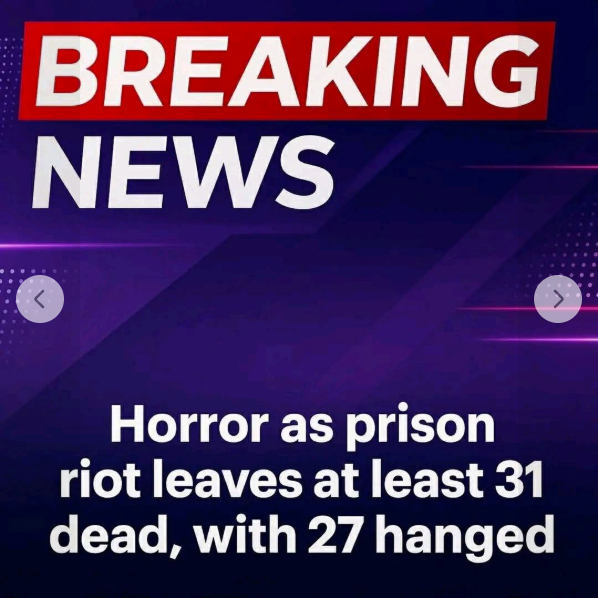
A shocking social-media post claims that a prison riot left at least 31 people dead, including 27 prisoners who were hanged, while people living nearby reported hearing gunshots, explosions and cries for help.
Unlike many viral “breaking news” posts that mix real events with invented details, this particular claim is based on a real and exceptionally serious incident. The tragedy occurred at the Machala prison in Ecuador on November 9, 2025. Ecuador’s prison authority reported that 31 inmates died during two violent episodes at the facility that day. Twenty-seven of the prisoners were later found dead after what authorities described as asphyxiation and death by hanging, while four others died during an earlier violent confrontation.
Residents near the prison also reported hearing gunfire, explosions and cries for help during the violence. However, some important details surrounding the deaths remained under investigation at the time, meaning viral posts should not automatically be interpreted as a complete account of exactly what happened to every victim.
The story also needs to be placed in the much larger context of Ecuador's prison crisis, where organized criminal groups have fought for control of facilities, and where repeated massacres have occurred in recent years.
The prison at the center of the tragedy was located in Machala, a city in Ecuador's El Oro province, in the southwestern part of the country.
On November 9, 2025, violence erupted inside the prison. According to Ecuador's prison authorities, the day's events involved more than one episode of violence.
The first major confrontation occurred during the early hours of the morning. Prisoners became involved in an armed clash, and police and security forces were called to regain control of the facility.
Authorities eventually managed to contain that outbreak.
But the violence did not end there.
Later that day, prison authorities discovered another group of dead inmates inside the facility. By the time authorities had accounted for the victims, the death toll had reached at least 31.
That distinction is important because some headlines describe the event simply as a "riot that killed 31 people." The reality was more complicated: the 31 deaths were connected to two violent episodes at the same prison on the same day.
One of the most disturbing aspects of the incident was the discovery of 27 dead prisoners.
Ecuador's national prison authority, SNAI, reported that the prisoners had died from asphyxiation associated with what it described as "immediate death by hanging."
The authorities initially emphasized that investigators were still working to establish the full circumstances.
This is an important distinction when discussing the tragedy.
A headline saying "27 prisoners were hanged" can sound as though every detail of how and why the deaths occurred has already been conclusively established.
But the official reports at the time were more cautious.
Authorities confirmed the deaths and described the apparent mechanism of death, while investigations and forensic examinations were still necessary to establish exactly what happened.
That is why responsible reporting should avoid presenting unverified theories as established facts.
The shocking number of deaths, however, was not merely a social-media invention. Major international news organizations reported the same basic figures.
Reuters reported that 27 prisoners in Machala died from asphyxiation and what SNAI called "immediate death by hanging."
The BBC likewise reported that at least 31 inmates had been found dead, including 27 who had been hanged, according to officials.
The remaining four deaths occurred during an earlier violent confrontation at the same prison.
According to authorities, armed fighting broke out among prisoners during the early morning hours.
The confrontation involved weapons and extreme violence, and tactical police units were eventually sent into the prison to restore control.
Reports said dozens of prisoners were injured, along with at least one police officer. Al Jazeera reported that 33 inmates and one police officer were injured.
Other local reporting gave a somewhat different injury count during the initial episode, illustrating why casualty figures in fast-moving disasters can change as authorities investigate.
This is one reason it is better to say "at least 31" rather than presenting the number as though every detail was immediately finalized.
The part of the viral caption describing people hearing gunshots, explosions and cries for help is also connected to real reporting.
People living near the prison reported hearing sounds of violence coming from inside the facility.
Al Jazeera reported that residents heard gunfire, explosions and cries for help during the unrest.
The reports help illustrate why the incident became such a frightening event for people living around the prison.
A prison is supposed to separate violent offenders from the surrounding population.
But when a major prison riot breaks out in the middle of an urban area, the consequences can extend beyond the walls.
Nearby residents may hear gunfire without knowing who is firing.
They may hear explosions without knowing what caused them.
Families may have relatives inside the facility and have no immediate information about whether they are safe.
And emergency responders must enter an environment where the security situation can change from minute to minute.
That was the atmosphere surrounding the Machala prison on that day.
One of the central questions was what triggered the violence.
Authorities linked the unrest to changes involving the organization and transfer of prisoners.
At the time, Ecuador was preparing to move high-risk inmates into a newly built maximum-security facility.
The government had been pursuing a strategy of separating dangerous prisoners and reducing the ability of criminal organizations to coordinate activities from inside prisons.
Reuters reported that the initial riot was connected to a reorganization of prisoners in preparation for transfers to a new maximum-security facility.
This is significant because prison transfers can be extremely sensitive in environments where different criminal groups compete for territory and influence.
Moving prisoners can change who occupies particular wings or cells.
It can separate members of the same organization.
It can place rival groups closer together.
And it can disrupt informal systems of power that prisoners have established inside a facility.
In Ecuador, those dynamics became particularly dangerous because criminal organizations had gained substantial influence inside parts of the prison system.
The Machala tragedy did not occur in isolation.
For years, Ecuador has experienced severe prison violence.
The country's prisons have been affected by overcrowding, weak institutional control, corruption, weapons trafficking and competition between organized criminal groups.
Since 2021, hundreds of prisoners have been killed in prison violence across the country.
The situation became internationally notorious after repeated prison massacres in which rival gangs fought using firearms and other weapons.
The violence has also been connected to Ecuador's changing role in international drug trafficking.
The country sits between major cocaine-producing regions in Colombia and Peru and has important Pacific ports.
Criminal organizations have competed for control of trafficking routes and logistical networks.
Those conflicts have increasingly affected prisons.
Perhaps the most disturbing part of the story is that the November tragedy was not the first deadly incident at the Machala prison in 2025.
Only weeks earlier, another major outbreak of violence had occurred at the same facility.
In September 2025, gang fighting at Machala resulted in 14 deaths and 14 injuries, according to Reuters.
That meant authorities were dealing with a prison that had already demonstrated how quickly violence could escalate.
And the violence was not limited to Machala.
Days after the September incident, another prison riot in Esmeraldas, northern Ecuador, killed 17 people.
The repeated incidents showed that the problem was national rather than simply local.
The government response included the development of a new maximum-security facility intended to house high-risk prisoners.
Reuters reported that Ecuador transferred around 300 high-risk inmates to a newly built maximum-security prison in Santa Elena province shortly after the Machala violence.
The facility was designed in part to isolate dangerous prisoners and reduce their ability to communicate with criminal organizations outside prison.
The government's argument was that prisons should not function as command centers for organized crime.
But moving prisoners is itself a complicated operation.
A prison system cannot simply move hundreds of people without considering security classifications, rival organizations, legal procedures, medical needs and the potential reaction of prisoners.
The Machala violence demonstrated how disruptive such changes could become.
The consequences did not end when police regained control.
Investigators began examining the deaths.
Forensic personnel were involved in identifying victims and determining causes of death.
Authorities also continued investigating the criminal organizations believed to be involved in the violence.
The incident became another major case in Ecuador's ongoing struggle to restore state control inside prisons.
And the story continued to develop well after the original November 2025 headlines.
One of the most significant developments came in 2026.
By March 2026, Ecuadorian reporting indicated that the Machala prison was headed toward permanent closure after prisoners were transferred elsewhere.
Primicias reported that more than 400 prisoners still remained at the facility in March, with plans for the prison to close permanently after transfers were completed.
The decision was significant because the prison had become associated with years of violence, overcrowding and security problems.
The facility had operated for more than seven decades.
By that point, it had become a symbol of the larger problems confronting Ecuador's prison system.
The government and lawmakers did not limit their response to prison transfers.
In March 2026, Ecuador's National Assembly approved a bill aimed at strengthening the prison system and reducing organized crime's influence over prisons.
The Assembly said the legislation was intended to restore institutional state control, prevent criminal organizations from reorganizing inside prisons and ensure that sentences are carried out within a framework of legality and respect for human rights.
In April, the Assembly took another step toward sending the reform to the country's official register after considering objections from President Daniel Noboa.
The reforms demonstrate that the Machala tragedy became part of a broader debate over how Ecuador should manage its prison system.
There has also been a significant legal development related to earlier violence at the Machala facility.
In September 2026, Ecuador's Attorney General's Office announced that five prisoners had been sentenced to 40 years in prison after being convicted of terrorism for their participation in an episode of extreme violence at the Machala prison.
According to the prosecutor's office, the case concerned the events of September 22, 2025, when violence at the prison resulted in 16 deaths and 14 injuries. Investigators said firearms, bladed weapons and explosives were used.
This case is separate from the November 9 massacre described in the viral image.
There were several deadly incidents at Machala in 2025, and social-media posts can easily blend details from different events together.
The September case involved 16 deaths.
The November 9 violence involved at least 31 deaths.
The Machala post demonstrates an important lesson about viral news.
A post can contain a real event while still presenting incomplete or exaggerated information.
The central claim here — that at least 31 prisoners died at Machala prison and that 27 were found dead after hanging/asphyxiation — is supported by multiple reputable news reports and Ecuadorian authorities.
The reference to residents hearing gunshots, explosions and cries for help is also supported by contemporary reporting.
But social-media language often removes important qualifications.
For example, saying "27 prisoners were hanged" does not automatically explain:
Those questions require investigation.
It can be easy to read a headline such as "31 dead" and move on.
But every number represented a person.
Some had parents waiting for phone calls.
Some had spouses or other relatives who may have learned about the deaths through news reports rather than direct communication.
For prison families, these incidents can be particularly traumatic.
When violence breaks out, relatives outside the prison may spend hours trying to discover whether their loved one is alive.
They may gather outside the prison gates.
They may search social media for information.
And in many cases, official casualty lists are not immediately available.
The Machala tragedy therefore affected more people than the 31 individuals counted in the death toll.
At the heart of Ecuador's prison crisis is a fundamental question:
Who actually controls the inside of a prison?
In a functioning correctional system, the state is responsible for security.
Prison officials control movement.
Gang leaders cannot openly command armed groups.
And prisoners are separated according to security requirements.
But Ecuador's prison crisis has demonstrated how difficult that model can become when organized criminal groups establish influence inside facilities.
If gangs control sections of prisons, then transferring inmates, searching cells or separating rival groups can potentially trigger violent resistance.
Authorities attempt to restore control.
More security measures are introduced.
And prisoners are moved or reorganized again.
Breaking that cycle requires more than simply responding to individual riots.
Let's separate the major statements in the image from what credible reporting established.
Ecuadorian authorities reported at least 31 inmate deaths at the Machala prison on November 9, 2025.
Supported with an important qualification.
Officials reported that 27 prisoners died from asphyxiation associated with hanging or suspension. Authorities were still working to establish the full circumstances of the deaths.
Contemporary reports described residents hearing gunfire from the prison.
Reports also described explosions during the violence.
Al Jazeera reported that residents described hearing cries for help from inside the prison.
Not supported by the broader record.
Machala had experienced other deadly prison violence before the November massacre, including a September incident that killed 14 people. Ecuador as a whole had experienced numerous prison massacres in the preceding years.
Although the original tragedy happened in November 2025, its consequences have continued.
The Machala prison's future changed.
Ecuador continued reforming its prison system.
New maximum-security facilities became part of the government's strategy.
And criminal cases arising from prison violence continued moving through the courts.
The September 2026 sentencing of five prisoners connected to an earlier Machala massacre is evidence that investigations into the prison violence have continued beyond the initial news cycle.
That is an important reminder about major breaking-news stories.
The first headline tells us what happened immediately.
The months and years afterward often reveal who was responsible, how authorities responded and whether institutional changes were made.
The viral post is based on a real tragedy, not a completely fabricated story.
On November 9, 2025, a deadly series of violent incidents occurred inside Ecuador's Machala prison. At least 31 inmates died. Four were killed during an earlier violent confrontation, while another 27 were later found dead after authorities reported deaths involving hanging and asphyxiation. Dozens of other prisoners and at least one police officer were injured during the day's violence.
Residents near the prison reported hearing gunshots, explosions and cries for help, making the incident frightening not only for prisoners and their families but also for the surrounding community.
However, the most responsible way to describe the event is to distinguish confirmed facts from unanswered questions. Authorities themselves said they were still working to clarify the circumstances surrounding the deaths.
The tragedy was also not an isolated episode. Machala had already experienced deadly prison violence earlier in 2025, and Ecuador had endured years of prison massacres connected to rival criminal organizations, overcrowding and the struggle for control of correctional facilities.
Since then, Ecuador has pursued prison transfers, new maximum-security infrastructure and legal reforms intended to strengthen institutional control. The Machala facility itself has been targeted for permanent closure after prisoners were transferred elsewhere.
And as of September 2026, legal proceedings connected to earlier violence at the prison have continued, including a recent 40-year sentence for five prisoners convicted over a separate September 2025 massacre.
In short: the core claim in the viral image is substantially supported by credible reporting, but the full circumstances surrounding the 27 deaths require careful wording. The horror described in the post was real; the complete story is more complicated than the headline suggests.



0 comments:
Post a Comment