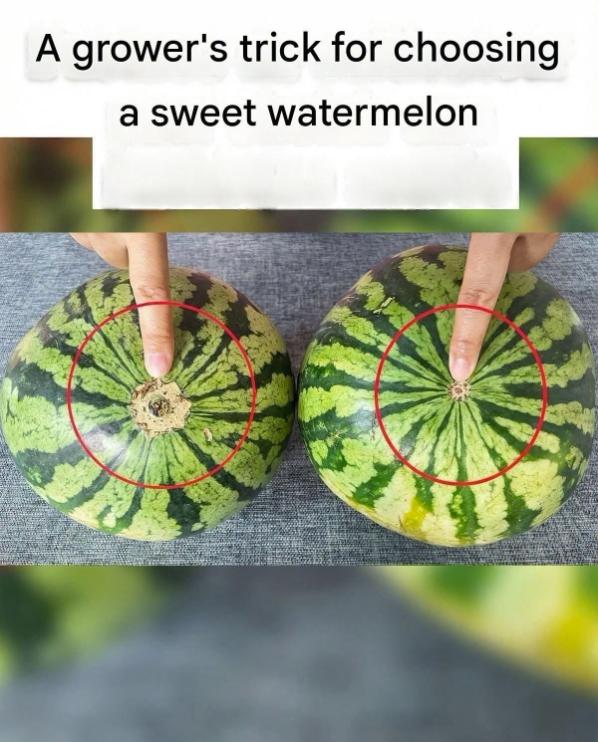
Picking a watermelon can sometimes feel like a guessing game.
You stand in front of a pile of nearly identical green melons, tap a few of them, turn them over, and wonder which one will be sweet, juicy and perfectly ripe inside.
The good news is that you don't have to completely rely on luck.
There are several visual and physical clues that can help you choose a better watermelon. One of the most useful is found on the bottom of the fruit: the field spot.
This is the area where the watermelon rested on the ground while it was growing.
Its color can provide a useful clue about how long the watermelon remained on the vine and how mature it was when harvested.
But the field spot isn't the only thing to look at.
If you combine several signs—color, weight, shape, firmness and the stem—you can make a much more informed choice.
Here's what to look for the next time you're shopping for watermelon.
1. Look for a Creamy Yellow Field Spot
Turn the watermelon over and look for the large discolored patch on one side.
This is called the field spot.
It develops because that portion of the watermelon was resting against the ground while the fruit grew.
A watermelon with a creamy yellow or deep yellow field spot is generally a better choice than one with a very pale white or greenish spot.
Why?
The color indicates that the fruit had time to develop while resting on the ground.
A white field spot doesn't automatically mean the watermelon is bad. However, a clearly developed yellow or creamy-yellow patch is one of the useful visual clues shoppers can look for.
The image above shows two different-looking field spots, which is why this part of the watermelon is worth checking before you buy.
What you're looking for:
Good sign: creamy yellow to yellow-orange field spot.
Less useful sign: very pale white or greenish field spot.
Don't judge the entire watermelon from this one feature alone, though.
Use it together with the other clues below.
2. Choose a Watermelon That Feels Heavy
One of the simplest tricks is also one of the most useful.
Pick up the watermelon.
Compare it with another watermelon of a similar size.
The heavier one is often the better choice.
Why?
Watermelon contains a lot of water, so a fruit that feels heavy for its size may have a good amount of juicy flesh.
You don't need a scale.
Simply hold two similarly sized watermelons and compare them.
If one feels surprisingly heavy, put it on your shortlist.
This technique is particularly useful when several watermelons look almost identical from the outside.
3. Look at the Shape
A good watermelon is generally symmetrical and evenly developed.
Depending on the variety, watermelons can be round, oval or elongated.
The exact shape isn't necessarily a measure of sweetness.
However, avoid fruits with major irregularities, deep indentations or unusual soft areas.
A uniformly shaped watermelon can be a practical choice, especially when you're comparing several fruits.
Don't reject an elongated watermelon simply because it isn't perfectly round.
Variety matters.
4. Check the Color of the Rind
The outer rind can tell you something about the fruit.
A ripe watermelon often has a strong contrast between its darker and lighter green areas.
The surface should generally look mature rather than extremely bright and glossy.
However, watermelon varieties differ considerably.
Some naturally have lighter skins, different stripe patterns or unusual colors.
So don't use rind color as your only test.
Instead, consider it one piece of the puzzle.
5. Look for a Dull, Rather Than Extremely Shiny, Surface
A very shiny watermelon isn't automatically unripe, but many shoppers use the surface appearance as another clue.
A mature watermelon may have a somewhat duller appearance compared with a very bright, glossy young fruit.
Again, this isn't a perfect test.
The variety, growing conditions and handling can affect the appearance of the rind.
If the watermelon has a good field spot, feels heavy and has a healthy-looking rind, those clues together are more useful than surface shine alone.
6. Check the Stem When Possible
If the watermelon still has part of its stem attached, take a look at it.
A dry, brownish stem can be a useful indication that the fruit has reached a more mature stage.
A very green stem may suggest that the fruit was harvested relatively recently.
But there's an important limitation.
The stem's appearance can change after harvest, so it isn't a guaranteed freshness test.
It's better to use the stem as an additional clue rather than treating it as proof that the watermelon will be sweet.
7. Try the "Knock" Test
You've probably seen people tapping watermelons at the supermarket.
There's a reason the technique became popular.
Some shoppers believe a ripe watermelon should produce a deeper, fuller sound when tapped, while an immature or overripe fruit may sound different.
The problem is that the tapping method is subjective.
Two people can tap the same watermelon and interpret the sound differently.
So if you like using the technique, use it as an additional clue—not as your main method of choosing.
If you're not confident distinguishing the sounds, don't worry.
The field spot and weight can be easier clues for many shoppers.
8. Avoid Soft or Damaged Areas
Inspect the watermelon carefully.
Look for:
- Very soft spots
- Deep cuts
- Cracks
- Large bruises
- Leaking areas
- Mold
- Unusual sunken patches
A few superficial marks aren't necessarily a problem.
Watermelons can develop harmless scratches and scars while growing or during transportation.
But a watermelon with a large soft, wet or damaged area may not be the best choice.
When possible, select a fruit with a firm exterior and no obvious signs of deterioration.
9. Don't Automatically Choose the Biggest Watermelon
Bigger doesn't necessarily mean sweeter.
A huge watermelon can be delicious, but size alone doesn't tell you how it will taste.
Instead of looking for the biggest fruit in the pile, compare watermelons of similar size and choose one that feels heavy for its size.
This combines two useful clues:
Size + weight.
A watermelon that feels surprisingly heavy compared with another watermelon of similar dimensions may contain plenty of juicy flesh.
10. The Yellow Spot Isn't a "Sugar Meter"
There's a popular idea online that the exact shape or size of the field spot can tell you whether a watermelon is male or female, or that one particular shape guarantees sweetness.
These claims are often exaggerated.
Watermelons don't need to be classified into supermarket "male" and "female" categories to determine whether they're sweet.
The field spot is useful primarily because it shows where the fruit rested on the ground during growth.
Its color can provide a maturity clue, but no external feature can guarantee the exact sweetness of the flesh inside.
That's why it's better to combine several signs.
Why Does the Field Spot Turn Yellow?
The field spot is simply the area that doesn't receive the same exposure to sunlight as the rest of the rind.
While the watermelon grows, one side remains against the soil.
As the fruit develops, that area can change color.
A creamy yellow field spot is commonly considered a favorable sign when selecting a ripe watermelon.
A very pale or white field spot may indicate that the fruit was harvested at a different stage of maturity.
However, growing conditions and watermelon varieties can influence the appearance.
That's why you shouldn't use the field spot as an absolute guarantee.



0 comments:
Post a Comment