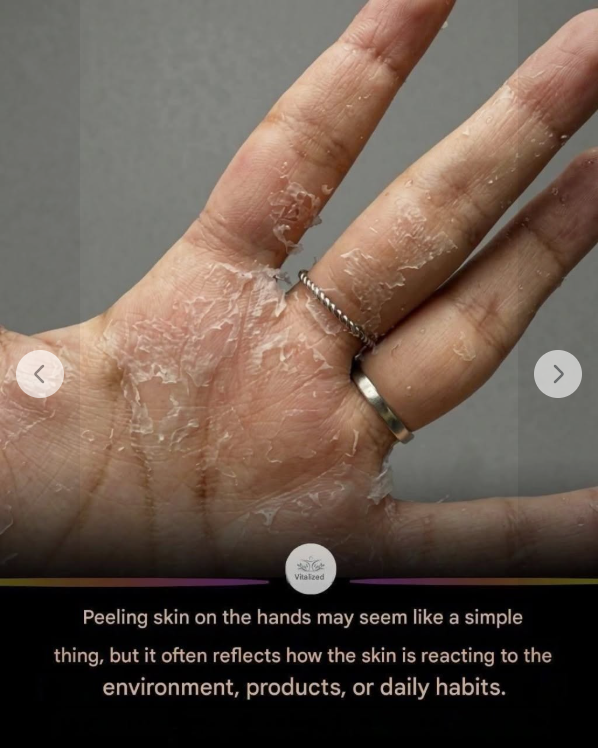
Peeling skin on the hands can look alarming.
One day, your hands may feel completely normal. The next, the skin around your fingertips, palms or knuckles may begin flaking, shedding or forming small areas that seem to come away in layers. Sometimes the peeling is barely noticeable. Other times, it can be accompanied by dryness, redness, itching, burning, cracks or pain.
Because our hands are exposed to so much every day, there are many possible reasons for this change.
Frequent handwashing, cleaning products, cold or dry weather and prolonged contact with water can all interfere with the skin's protective barrier. But peeling can also occur with hand eczema, contact dermatitis, fungal infections, psoriasis and a condition known as keratolysis exfoliativa.
The good news is that peeling hands are often manageable once the underlying trigger is identified.
The important part is not to assume that every case is simply “dry skin.”
Before considering why your hands are peeling, it helps to understand what the skin is supposed to do.
The outermost layer of the skin acts as a protective barrier. It helps limit water loss while also providing protection against irritants, allergens and microorganisms.
When that barrier is damaged, the skin can become dry, rough, irritated and more vulnerable to further damage.
The American Academy of Dermatology explains that frequent wetting and insufficient moisturizing can compromise the hands' barrier, allowing irritants and allergens to penetrate more easily.
Think of the barrier as a protective wall.
When the wall is intact, the skin can better tolerate everyday exposure.
When it becomes cracked or stripped, ordinary things that would normally cause little trouble can begin to sting.
Hand sanitizer may feel uncomfortable.
Cleaning products may trigger redness.
And the surface may begin to peel.
Sometimes the explanation really is as simple as excessive dryness.
The outer layer of skin naturally sheds dead cells, but when skin becomes excessively dry, visible peeling can occur. The American Academy of Dermatology notes that excessively dry skin may peel and can also become raw, cracked and painful.
Hands are particularly vulnerable because they are repeatedly exposed to water, soap, weather and friction.
Indoor heating can make the surrounding air drier.
Frequent washing can remove some of the skin's natural oils.
Cleaning and household chores can expose the hands to additional irritants.
As the skin becomes progressively drier, small flakes may appear. In more severe cases, cracks can develop and even bleed.
This does not necessarily mean that something is seriously wrong inside the body.
Often, the skin simply needs less irritation and more consistent barrier protection.
Handwashing is essential for preventing the spread of infection.
The answer to dry or peeling hands is therefore not to stop washing your hands when washing is needed.
Instead, the goal is to wash appropriately while reducing unnecessary irritation.
According to dermatologists at the American Academy of Dermatology, washing with lukewarm rather than very hot water, using a less-drying cleanser and moisturizing immediately afterward can help reduce dryness.
After washing, gently dry the hands while leaving them slightly damp, then apply a cream or ointment.
This simple step can make a major difference when repeated throughout the day.
The AAD recommends moisturizers that are fragrance-free and dye-free, with ingredients such as petrolatum or mineral oil often being well tolerated by dry, chapped skin.
Not all soaps and cleansers affect the skin in exactly the same way.
Some people can use strongly fragranced or highly cleansing products without obvious irritation.
Others develop dryness quickly.
The same is true of household products.
Detergents, bleach, disinfectants, solvents, fertilizers and other chemicals can irritate the hands. The American Academy of Dermatology identifies these substances among common triggers of irritant contact dermatitis.
The risk becomes greater when exposure is frequent.
Someone who washes dishes several times a day may repeatedly expose the skin to water and detergent.
A cleaner may handle disinfectants.
A hairdresser may frequently come into contact with hair dyes and other products.
A healthcare worker may wash or sanitize their hands repeatedly during the workday.
A construction worker may encounter cement, solvents or other materials.
Over time, repeated exposure can overwhelm the skin barrier.
Another common explanation is contact dermatitis.
Contact dermatitis occurs when the skin reacts to something that touches it.
There are two major forms: irritant contact dermatitis and allergic contact dermatitis.
This happens when a substance or repeated exposure directly damages or irritates the skin.
and frequent exposure to water.
Hands are particularly susceptible because they come into contact with so many substances.
Symptoms can range from dryness and burning to redness, scaling, cracking and blistering.
This occurs when the immune system reacts to a substance that has become an allergen for the individual.
Potential triggers can include certain ingredients in personal-care products, rubber or latex, metals and other substances.
The reaction may not always occur immediately after contact. Depending on the allergen, symptoms can appear after a delay.
If your hands consistently worsen after using a particular product, wearing certain gloves or handling a specific substance, contact dermatitis becomes an important possibility.
Hand eczema is another common explanation for persistent peeling, but it is easy to mistake for simple dry skin.
The American Academy of Dermatology describes hand eczema as a condition that can produce dry, chapped skin, irritated patches, scaling, itching, burning, blisters and painful cracks. Severe cases may bleed or weep.
One important clue is that the problem does not improve adequately with ordinary moisturizing alone.
A person may apply cream repeatedly and still experience significant inflammation, cracking or recurrent flares.
In that situation, the issue may be more than dehydration.
The underlying inflammation and trigger need to be addressed.
Hand eczema can result from irritant exposure, allergic reactions or a combination of factors.
People who spend a lot of time with wet hands may be at greater risk.
People who handle chemicals or cleaning products may also be affected.
A history of atopic dermatitis or eczema earlier in life can increase the likelihood of developing hand eczema.
This is why simply buying a thicker moisturizer may not completely solve the problem.
The treatment needs to match the cause.
A dermatologist may recommend avoiding specific triggers and may prescribe anti-inflammatory treatment when appropriate.
Some forms of hand eczema begin with tiny, intensely itchy blisters.
This is commonly known as dyshidrotic eczema.
According to the American Academy of Dermatology, small blisters on the hands or feet are a characteristic feature, and after the blisters resolve, the skin can become dry, irritated and scaly.
The itching can be considerable.
People may instinctively scratch or peel the affected skin, which can make the barrier even more damaged.
For this reason, gentle care is particularly important.
The AAD recommends fragrance-free creams or ointments rather than thinner lotions and emphasizes protecting the skin from irritants.
There is another condition that can produce very characteristic peeling on the palms and fingers: keratolysis exfoliativa, also called focal palmar peeling or exfoliative keratolysis.
DermNet describes it as a common condition involving superficial peeling of the palms and sometimes the soles.
It can begin with small superficial air-filled blisters.
Those areas may then burst and leave circular or oval areas of peeling skin.
Unlike many forms of eczema, keratolysis exfoliativa is generally not itchy.
The peeled areas may feel tender or become dry and cracked because their normal barrier has temporarily been lost.
DermNet notes that exposure to irritants such as water, soap, detergents and solvents can aggravate it.
This is one reason an accurate diagnosis can matter.
Peeling hands do not automatically mean eczema.
Fungal infections are another possibility, particularly when the appearance is asymmetric or when there are other signs of fungal infection elsewhere.
DermNet notes that tinea manuum, a fungal infection affecting the hand, can present with dryness and peeling and may sometimes be associated with fungal infection of the feet.
This can sometimes produce a pattern different from ordinary dry skin.
A person may have scaling predominantly on one hand or have a particularly noticeable border to the affected area.
Because fungal infections require different treatment from eczema, repeatedly applying eczema treatments without a diagnosis may not solve the problem.
A healthcare professional can determine whether a fungal infection should be considered and, when appropriate, perform testing.
Psoriasis can also occur on the palms and hands.
DermNet lists palmoplantar psoriasis among conditions that can produce scaly changes on the hands.
Psoriasis can produce well-defined plaques and thickened skin.
Depending on the individual, it may crack or become painful.
Again, appearance alone is not always enough to make a diagnosis.
Several different skin conditions can look similar at first glance.
The pattern, duration, symptoms, other affected areas and response to treatment all help clinicians determine the likely cause.
When loose skin appears, it can be tempting to pull it away.
Sometimes the hanging piece is annoying or catches on clothing.
But repeatedly picking, cutting or peeling the skin can further disrupt the barrier.
A seemingly minor area can become a painful crack.
Once the skin is damaged, irritants and microorganisms have easier access to deeper tissue. The AAD notes that severely dry, cracked skin can develop fissures and subsequent infections.
Instead of pulling aggressively at loose skin, focus on protecting and moisturizing the area.
Allow the skin to repair itself.
If there is a large flap of skin or a painful fissure, a medical professional can advise on appropriate care.
Skin-barrier care does not require an elaborate routine.
In many cases, consistency matters more than complexity.
Start by using a gentle, fragrance-free cleanser.
Avoid unnecessary exposure to harsh detergents and chemicals.
Then immediately apply a thick cream or ointment.
The American Academy of Dermatology recommends creams or ointments over thin lotions for very dry hands and lists ingredients such as petrolatum, mineral oil, glycerin, dimethicone, lactic acid, hyaluronic acid and shea butter among options that can help dry skin.
You do not necessarily need every ingredient.
The best product is often one that is comfortable enough for you to use consistently.
When skin is peeling and cracked, a very light lotion may not provide enough protection.
Creams and ointments tend to be thicker and can help reduce water loss.
The AAD specifically recommends fragrance-free cream or ointment for hand eczema and very dry skin.
An ointment containing petrolatum can be particularly useful for heavily dry areas.
It may feel greasy, especially during the day, but using a thicker product at night can be practical.
Some people apply a generous layer before bed so the hands have several uninterrupted hours of protection.
One of the simplest habits to adopt is also one of the most useful.
After washing your hands, moisturize.
The AAD recommends applying hand cream or ointment after handwashing, particularly when the skin is dry or chapped.
This does not make handwashing ineffective.
Rather, it helps restore some of the moisture and barrier protection that frequent washing can compromise.
Keeping a small tube of fragrance-free hand cream near the sink can make the habit easier.
You can also keep one in a bag, at work or beside your bed.
Consistency matters because the barrier is continually exposed throughout the day.
Someone with irritated hands may be tempted to reduce washing dramatically.
That is not advisable simply because the skin is dry.
Hand hygiene remains important for reducing transmission of infections.
The AAD specifically notes that people should continue washing their hands as needed while using moisturizer to address dryness.
The goal is not to choose between hygiene and healthy skin.
It is to practice both in a skin-friendly way.
If your hands become worse after washing dishes, cleaning or gardening, gloves can provide an important barrier.
The AAD recommends protective gloves for activities such as washing dishes, gardening or repeated immersion in water.
A glove that traps sweat for long periods may itself irritate some people's skin.
Some individuals also develop allergic reactions to glove materials.
If you repeatedly develop a rash while wearing a particular glove, the glove itself may need to be considered as a potential trigger.
A healthcare professional can help determine whether an allergic or irritant reaction is involved.
When skin is irritated, a complicated collection of creams, scrubs, oils and fragranced products may do more harm than good.
The American Academy of Dermatology recommends fragrance-free products for dry and sensitive skin and warns that certain ingredients can irritate already dry skin.
This applies to hand creams as well as soaps and cleansers.
A product labeled “natural” is not automatically non-irritating.
Plants and botanical ingredients can cause irritation or allergic reactions in some individuals. The AAD notes that even skincare products marketed as “natural” or “clean” can cause contact dermatitis.
When your barrier is damaged, simple is often better.
People often concentrate on the palms because peeling is more obvious there.
But the backs of the hands are also exposed to the environment.
Sun exposure, cold air, wind, frequent washing and household chemicals can all affect them.
The AAD recommends applying sunscreen to exposed hands as part of routine sun protection, noting that the hands can develop sun-related changes such as roughness, discoloration and actinic keratoses.
A peeling problem should not be treated by aggressively exfoliating sun-damaged skin.
Exfoliation can further strip an already compromised barrier.
Moisturizing and sun protection are usually more appropriate starting points.
When skin is visibly peeling, exfoliating can seem logical.
It may feel satisfying to remove flakes.
But peeling skin is often a sign that the barrier is already stressed.
The AAD advises against exfoliating excessively dry skin because doing so can further strip moisture.
Scrubs containing abrasive particles can create tiny areas of additional irritation.
Likewise, aggressive brushes or repeated scraping can worsen cracks and inflammation.
The goal is to support healthy skin turnover, not force damaged skin to disappear faster.
Moisturizer is helpful, but it is not a universal treatment.
If the skin remains red, inflamed, itchy, blistered or painful despite good barrier care, another condition may be involved.
The AAD notes that people with extremely dry, painful hands who do not improve with regular moisturizing may actually have hand eczema and may need evaluation and treatment beyond moisturization.
This is particularly important when symptoms keep recurring.
A temporary flare after unusually cold weather may be one thing.
A pattern that returns every few weeks or persists for months is different.
Peeling mainly on the palms may be seen with keratolysis exfoliativa.
Peeling between the fingers may fit certain forms of dermatitis.
One-sided scaling can raise the possibility of fungal infection.
Blisters followed by peeling may suggest a specific type of eczema.
Dryness across the entire hand may fit irritant dermatitis or simple xerosis.
But these patterns are not diagnostic on their own.
DermNet emphasizes that several conditions can resemble one another, including hand dermatitis, keratolysis exfoliativa, psoriasis and tinea manuum.
A clinician looks at the complete picture rather than one symptom.
One of the most useful questions is:
Did you begin washing your hands more frequently?
Did you start using a new soap?
Did you begin working with a cleaning chemical?
Did you start using a new hand sanitizer?
Did you begin wearing a different kind of glove?
Did the weather suddenly become colder and drier?
Did you start using a new nail product?
Did the symptoms appear after a vacation, job change or new hobby?
A timeline can sometimes reveal a trigger.
Contact dermatitis may develop after exposure to an irritant or allergen, and symptoms can appear immediately or after a delay depending on the cause.
For recurring peeling, a simple written record can be surprisingly useful.
Write down when the peeling begins.
Write down whether there is itching, burning, blistering or pain.
Also note whether your feet or other areas of your body are affected.
This information can help a dermatologist identify patterns.
It can also prevent you from repeatedly trying products that may be aggravating the condition.
Small cracks can hurt, especially around the fingertips and knuckles.
The AAD notes that hand eczema can cause deep, painful cracks, bleeding and weeping skin.
Once the skin is cracked, ordinary activities become uncomfortable.
Even putting on a ring may be uncomfortable.
This is one reason treating the barrier early is worthwhile.
The longer the skin remains severely dry and inflamed, the more difficult everyday activities can become.
Damaged skin can sometimes become infected.
The NHS lists worsening symptoms, discharge, increasing pain and feeling generally unwell as warning signs that an area of contact dermatitis may have become infected. Feeling hot, cold or shivery can also be concerning.
The AAD similarly identifies yellow crusts, pus or fluid leakage, swelling and changes in skin color as possible signs of infection.
These symptoms should not be ignored.
An infection may require medical assessment and, depending on the cause and severity, prescription treatment.
You should consider seeing a healthcare professional if the peeling is persistent, severe, recurrent or accompanied by substantial inflammation.
Medical evaluation is particularly important when:
there are blisters or extensive inflammation,
symptoms are rapidly worsening,
the condition interferes with normal activities,
or moisturizer and avoidance of obvious irritants are not helping.
The AAD specifically advises evaluation when extremely dry, painful hands do not improve with regular moisturizer.
A dermatologist may be able to determine whether the problem is eczema, contact dermatitis, psoriasis, fungal infection, keratolysis exfoliativa or another condition.
Peeling limited to dry fingertips is very different from extensive peeling over large areas of the body.
If skin begins peeling widely and is accompanied by severe illness, extensive blistering, significant pain, fever or involvement of the mouth, eyes or other mucous membranes, urgent medical assessment is appropriate.
Such patterns can have causes that are very different from ordinary hand dryness.
The key point is that the extent and accompanying symptoms matter.
Do not assume that widespread skin peeling is simply an especially severe version of dry hands.
Online images can be helpful for education, but many skin conditions look similar.
A photograph may show peeling without revealing the history behind it.
It cannot tell you whether a chemical caused the problem.
It cannot reliably establish whether a fungus is present.
It cannot determine whether an allergen is involved.
And it cannot replace an examination when symptoms are persistent or severe.
This is especially important because treatments can work in opposite directions.
For example, DermNet notes that keratolysis exfoliativa does not improve with topical steroids, unlike hand dermatitis.
That is a good illustration of why identifying the condition matters.
A practical routine can be surprisingly short.
In the morning, wash your hands with lukewarm water and a gentle cleanser when needed. Apply a fragrance-free cream or ointment afterward.
During the day, repeat the moisturizer after washing.
Before cleaning, gardening or washing dishes, use appropriate protective gloves.
At night, apply a thicker cream or ointment to the hands, especially over areas that are visibly cracked or peeling.
The AAD recommends frequent moisturizing and specifically suggests creams or ointments containing ingredients such as petrolatum, mineral oil, glycerin or dimethicone for dry hands.
Petroleum jelly is one of the simplest barrier-protective ingredients available.
It works as an occlusive, helping reduce water loss from the skin.
The AAD recommends petrolatum-containing ointments for dry, chapped hands and specifically notes that petroleum jelly can be applied to dry hands and nails after washing.
Some people dislike its greasy texture during the day.
Nighttime is therefore often an easier opportunity to use it.
A thin layer can be applied over a moisturizer, or a petrolatum-based ointment can be used on its own depending on preference.
Internet advice often suggests lemon juice, vinegar, baking soda, essential oils or other household ingredients for peeling skin.
Already irritated skin is particularly vulnerable to additional irritation.
The AAD notes that even some “natural” skincare products can trigger contact dermatitis.
Adding more potentially irritating substances to compromised skin can make it harder to determine the original cause.
A bland, fragrance-free moisturizer or ointment is generally a more predictable choice for a damaged skin barrier.
Persistent or unusual symptoms deserve proper assessment rather than an endless series of home experiments.
Peeling skin is not necessarily a sign that something is seriously wrong.
Often, the hands are simply communicating that they have been exposed to more stress than their barrier can comfortably handle.
Maybe you have been washing them unusually often.
Maybe a new cleaning product is responsible.
Maybe eczema has become active.
Maybe a fungal infection or another skin condition is involved.
The pattern is what helps identify the cause.
The skin barrier generally benefits from three basic things:
less unnecessary irritation, adequate moisture and protection from further damage.
That means avoiding harsh cleansers when possible.
It means moisturizing consistently.
It means protecting the hands during activities involving chemicals or prolonged water exposure.
It means resisting the temptation to scrub away every flake.
And it means seeking professional guidance when the problem is severe or persistent.
Dermatologists specifically recommend minimizing contact with irritants and using emollients as part of hand-dermatitis care.
This is perhaps the most useful thing to remember.
Peeling skin is not a diagnosis.
It is a visible symptom that can have multiple causes.
Irritant contact dermatitis is another.
Allergic contact dermatitis is another.
Hand eczema, dyshidrotic eczema, keratolysis exfoliativa, fungal infections and psoriasis can also produce peeling or scaling.
That is why the details matter.
Is one hand affected more than the other?
How long has it been happening?
What products touch your hands every day?
Those questions can be much more informative than simply asking how to “get rid of peeling skin.”
Peeling skin on the hands can be frustrating, uncomfortable and sometimes worrying, but it is often a problem that can be improved with the right combination of gentle care and trigger avoidance.
Wash when necessary, but avoid excessively hot water and harsh cleansing.
Use a fragrance-free cream or ointment after handwashing.
Protect your hands during cleaning, gardening and prolonged water exposure.
Avoid picking or aggressively exfoliating peeling areas.
Pay attention to new products and workplace exposures.
And remember that persistent peeling may represent a skin condition that needs specific treatment rather than more moisturizer.
Most importantly, pay attention to warning signs.
Rapid worsening, increasing pain, pus or other discharge, yellow crusting, swelling, feeling unwell, extensive blistering or widespread skin involvement should prompt medical evaluation.
Your hands perform countless tasks every day.
They are exposed to water, soap, sunlight, weather, chemicals and friction more often than many other parts of the body.
When the skin starts peeling, it may simply be asking for protection.
Sometimes, however, it is telling you that something more specific is going on.
Listening to that signal — rather than automatically peeling, scrubbing or covering it up — is the first step toward getting your skin barrier healthy again.


0 comments:
Post a Comment