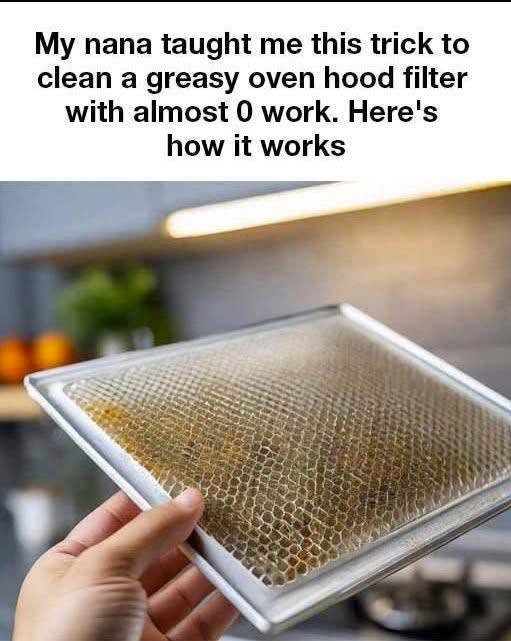
A greasy range hood filter can be one of those kitchen cleaning jobs that nobody looks forward to.
Over time, cooking oils, grease and food particles can build up on the filter, leaving behind a sticky layer that ordinary dish soap and a quick rinse may not remove. The longer the buildup sits there, the harder it can become to clean.
But there is a simple method that can make the job much easier.
Instead of spending a long time scrubbing the filter, you can soak it in very hot water with a degreasing solution, allowing the heat and cleaning agents to loosen much of the grease before you start scrubbing.
Here is how to do it.
Why Oven Hood Filters Get So Greasy
Whenever you cook, especially when frying, sautéing or preparing foods with oil, tiny droplets of grease can become airborne.
Your range hood is designed to capture some of those particles before they spread throughout the kitchen.
The filter catches grease and other cooking residue.
That's useful—but it also means the filter gradually becomes coated with oil.
A neglected filter may eventually look:
- Yellow or brown
- Sticky
- Dark around the edges
- Covered with thick grease
- Difficult to rinse clean
Cleaning the filter regularly can make the job much easier.
The Easy Soaking Method
You don't need an expensive specialty product.
For a typical metal, dishwasher-safe range hood filter, you can try:
What you'll need
- Very hot water
- A large sink, basin or container
- Dishwashing liquid with grease-cutting properties
- Baking soda
- A soft brush or old toothbrush
- Rubber gloves
- An old towel
Step 1: Remove the filter
Turn off the range hood and allow the cooking surface and surrounding area to cool.
Remove the filter according to your hood manufacturer's instructions.
Be careful when handling it because accumulated grease can make the filter slippery.
Step 2: Fill the Sink With Hot Water
Fill your sink or a suitable basin with very hot water.
The goal is to create a soaking solution that can penetrate the greasy buildup.
If your sink is too small, you can use a large plastic tub or another heat-resistant container.
Avoid using boiling water if your sink or container isn't designed to handle it.
Step 3: Add Dish Soap and Baking Soda
Add a generous amount of grease-cutting dishwashing liquid.
Then add several tablespoons of baking soda.
Stir the water carefully to distribute the ingredients.
The dish soap helps break up grease, while baking soda provides mild alkalinity and can help loosen stubborn residue.
You don't need an extremely precise measurement.
For a normal kitchen sink, a few tablespoons of baking soda and a good squeeze of dish soap are a reasonable starting point.
Step 4: Let the Filter Soak
Place the filter into the solution.
Make sure as much of the greasy surface as possible is submerged.
Now comes the part that saves you from excessive scrubbing.
Let it soak.
For a moderately dirty filter, give it around 15–30 minutes.
For heavier buildup, you may need longer.
As the filter sits in the hot solution, the heat and detergent have time to loosen the grease.
You may notice the water becoming cloudy, yellowish or brown.
That's a good indication that some of the accumulated residue is coming off.
Step 5: Give It a Gentle Scrub
After soaking, remove the filter carefully.
Put on gloves because the water and loosened grease can be unpleasant to handle.
Use a soft brush to gently scrub both sides.
You shouldn't need to attack the filter aggressively.
Pay particular attention to:
- Corners
- Edges
- Areas around the frame
- Heavily coated sections
- Small openings in the filter
If grease remains, place the filter back into the solution for another 10–15 minutes and repeat.
A second soak is often easier than trying to remove everything through hard scrubbing.
Step 6: Rinse Thoroughly
Once the grease has been removed, rinse the filter thoroughly under clean running water.
Make sure there isn't any remaining detergent or baking soda trapped inside the filter.
Hold it up and inspect it from different angles.
If you can still see a greasy film, repeat the soaking process.
Step 7: Let It Dry Completely
This step is easy to overlook.
Place the filter on a clean towel and allow it to dry completely.
Don't reinstall a wet filter.
Once it's completely dry, put it back into the range hood according to the manufacturer's instructions.
What If the Filter Is Extremely Greasy?
If the filter hasn't been cleaned for months—or even years—the first soak may not remove everything.
That's normal.
Heavy grease can become thick and sticky.
Instead of scrubbing aggressively for 30 minutes, try repeating the process.
A practical approach is:
Soak → gently scrub → rinse → inspect → repeat if necessary.
Two shorter cleaning cycles can be much easier than trying to remove years of buildup in one attempt.


0 comments:
Post a Comment