# The Truth Behind the Viral Uterus Image: Does Sex Cause Fibroids, Worms, or Other Growths?
A disturbing medical image has been circulating online with a sensational caption along the lines of: **“These are the consequences of having sex…”**
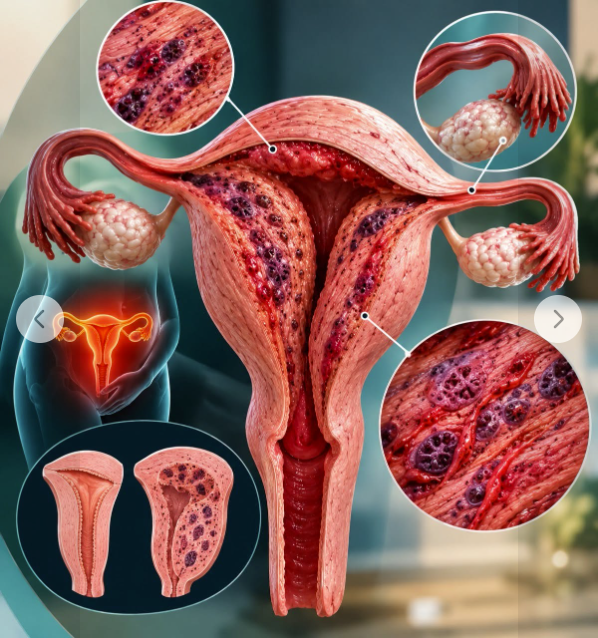
The illustration shows a cutaway view of a uterus filled with numerous white, rounded masses and several long, thread-like structures. To someone without medical training, it can look frightening—almost as though the uterus has become filled with parasites, worms, or accumulated material.
But the picture and the implication attached to it should not be taken at face value.
**The central claim is misleading and, if it suggests that ordinary sexual activity causes these growths or causes worms to accumulate inside the uterus, it is false.**
The structures shown are not a medically accurate representation of what happens inside a woman's uterus simply because she has sex. The rounded masses may be intended to resemble **uterine fibroids**, which are real and very common benign growths. However, fibroids do not arise because a woman has sexual intercourse. Their exact cause is not fully understood, although hormones such as estrogen and progesterone appear to influence their growth, and genetic and other biological factors are also involved.
The worm-like structures in the illustration are particularly misleading. There are rare medical reports of parasites reaching the female genital tract, including extremely unusual cases involving the uterus or cervix, but these are **not the normal consequence of having sex** and are not what happens to most sexually active women.
There is, however, an important part of the underlying health message that should not be dismissed. Sexual activity can transmit infections, and untreated sexually transmitted infections such as chlamydia and gonorrhea can lead to **pelvic inflammatory disease (PID)**. PID can damage the reproductive system and cause infertility, ectopic pregnancy, chronic pelvic pain and scarring.
So the accurate message is not “sex fills your uterus with worms and white balls.”
**Sex itself does not cause uterine fibroids, and the viral image does not accurately depict the consequences of sexual activity. But unprotected sex can increase the risk of sexually transmitted infections, some of which can cause serious reproductive-health complications if left untreated.**
The distinction is extremely important.
## What is actually shown in the image?
The first thing to understand is that the supplied picture is an **illustration**, not a diagnostic photograph.
It depicts a uterus opened so that the inside can be seen. Numerous pale, rounded structures occupy much of the uterine cavity and surrounding tissue, while elongated structures resembling worms appear lower down.
Real human anatomy does not normally look like this.
There is no single disease in which ordinary sexual activity causes a uterus to become packed with white balls and worms in this way.
The rounded structures are visually reminiscent of **fibroids**, also called leiomyomas or myomas. Fibroids are benign growths that develop from the muscle tissue of the uterus. They can occur as one growth or as multiple growths, and their size can range from very small nodules to masses several inches across.
Depending on their location, fibroids can grow within the muscular wall of the uterus, project into the uterine cavity, or grow toward the outside of the uterus.
That means a medically accurate illustration of multiple fibroids could indeed show numerous rounded masses associated with a uterus.
The answer is not sexual intercourse.
According to the American College of Obstetricians and Gynecologists (ACOG), the precise cause of fibroids remains unclear. Research suggests that hormones including estrogen and progesterone play a role in their growth. Family history may also contribute.
Fibroids are therefore a biological condition—not evidence that a woman has had “too much sex,” had sex with multiple partners, or somehow allowed semen or parasites to accumulate inside her uterus.
Uterine fibroids are among the most common growths found in the female pelvis.
They are **benign**, meaning that they are not cancerous in the overwhelming majority of cases. ACOG describes them as growths arising from the muscular tissue of the uterus.
Some women never know they have them because they cause no symptoms.
Other women experience significant problems.
* unusually heavy menstrual bleeding;
* longer or more frequent periods;
* pressure or fullness in the abdomen;
* difficulty with bowel movements;
* pain during sexual intercourse;
* anemia caused by heavy menstrual bleeding;
* and, in some cases, fertility problems.
The severity of symptoms depends heavily on the number, size and location of the fibroids.
A tiny fibroid that does not distort the uterine cavity may cause no problems whatsoever.
A much larger fibroid pressing against the bladder or bowel can cause significant discomfort.
A fibroid projecting into the uterine cavity can contribute to abnormal bleeding and, in some circumstances, reproductive difficulties.
This is why simply saying “fibroids are harmless” is also an oversimplification.
They are benign tumors, but they can still substantially affect someone's quality of life.
# Does having sex cause fibroids?
There is no established medical evidence that sexual intercourse causes uterine fibroids.
ACOG's explanation of fibroids focuses on biological and hormonal factors rather than sexual activity.
In fact, the relationship can work in the opposite direction: a woman who already has fibroids may experience **pain during sex**.
This can happen because a fibroid enlarges or changes the position of the uterus, creating pressure or discomfort during intercourse. ACOG lists pain during sex among possible symptoms of fibroids.
This distinction may explain how misinformation develops.
Someone may have fibroids, experience painful intercourse and then incorrectly conclude that sex caused the fibroids.
But correlation is not causation.
The fact that sexual intercourse may become painful in someone with fibroids does not mean intercourse created the fibroids.
# Can semen accumulate inside the uterus?
Another misconception associated with some viral reproductive-health images is the idea that semen remains inside the uterus and gradually builds up into lumps or “stones.”
That is not how the reproductive system works.
Following ejaculation, sperm enter the vagina and may travel through the cervix toward the uterus and fallopian tubes. Most sperm do not survive long enough to fertilize an egg, and the body clears reproductive fluids through normal physiological processes.
Semen does not normally sit inside the uterus for months or years and transform into white masses.
There is therefore no medically recognized condition in which ordinary sexual intercourse causes semen to accumulate inside the uterus until it looks like the material shown in this illustration.
If someone has abnormal material, discharge, bleeding or a mass in the reproductive tract, that requires a medical assessment rather than an assumption that it is “old semen.”
# What about the worm-like structures?
This is where the image becomes particularly misleading.
There **are** rare cases in medical literature involving parasites in unusual parts of the female reproductive tract.
For example, published case reports have documented *Enterobius vermicularis*, commonly known as pinworm, in the female genital tract. One report described an incidental finding of the parasite in endometrial tissue after hysterectomy. Another recent case report described thread-like worms emerging from the cervix of a pregnant patient and identified them as *E. vermicularis*.
But these cases are extraordinarily different from the claim made by the viral image.
They do **not** demonstrate that sexual activity routinely causes worms to enter the uterus.
Pinworm is primarily an intestinal infection. Its normal transmission occurs through ingestion of microscopic eggs, usually through contaminated hands or surfaces—not through sexual intercourse. Ectopic migration into the female genital tract is unusual.
A rare case report proves that something **can happen**, not that it is a common consequence of a particular behavior.
For example, medicine contains rare reports of unusual infections, tumors and complications involving almost every part of the human body. That does not mean those conditions are normal outcomes for the general population.
Therefore, the worm-like elements in the image should not be presented as a normal consequence of sex.
# Sex can cause reproductive-health problems—but for a different reason
Although the viral claim is wrong, sexual health does deserve serious attention.
The major concern is not that sexual intercourse physically creates fibroids.
The major concern is **sexually transmitted infections (STIs)**.
Some STIs can travel upward through the reproductive tract and cause pelvic inflammatory disease.
The CDC explains that PID is an infection of the female reproductive organs and that it is often caused by STIs such as chlamydia and gonorrhea. Other microorganisms that are not sexually transmitted can also contribute.
This is a genuine consequence associated with sexual activity.
# What is pelvic inflammatory disease?
PID is not one single infection but a spectrum of inflammatory conditions involving the upper female reproductive tract.
* endometritis, inflammation of the uterine lining;
* salpingitis, inflammation of the fallopian tubes;
PID can develop when bacteria move upward from the vagina and cervix into the upper reproductive tract.
Chlamydia and gonorrhea are particularly important causes.
The dangerous thing about these infections is that they can sometimes produce mild symptoms or no obvious symptoms at all.
A person can therefore have an infection without realizing that damage is occurring.
The CDC warns that untreated PID can result in scar tissue inside and around the fallopian tubes. That scarring can block the tubes, increasing the risk of infertility and ectopic pregnancy. Long-term pelvic or abdominal pain can also occur.
That is a real reproductive-health consequence worth taking seriously.
But it looks very different from the viral image.
PID is an infection and inflammatory process. It is not a uterus filled with white spheres and worms.
# The difference between fibroids, PID and endometriosis
Online medical misinformation often combines completely different conditions into one frightening picture.
Fibroids, PID and endometriosis are not the same thing.
Fibroids are benign growths arising from uterine muscle.
They can cause heavy bleeding, pelvic pressure, pain and sometimes reproductive difficulties.
Their exact cause is uncertain, with hormones and genetic factors among the important considerations.
### Pelvic inflammatory disease
PID is an infection/inflammatory condition involving the upper reproductive tract.
It can be associated with untreated STIs and can cause scarring, infertility, ectopic pregnancy and chronic pelvic pain.
Endometriosis is a chronic condition in which tissue resembling the lining of the uterus grows outside the uterus.
The World Health Organization estimates that endometriosis affects approximately **10% of reproductive-age women worldwide—about 190 million people**.
Symptoms can include severe menstrual pain, chronic pelvic pain, heavy bleeding, infertility, bloating and nausea.
Endometriosis can also make sexual intercourse painful.
But again, **sex does not cause endometriosis**.
WHO says the causes of endometriosis remain unknown, although research increasingly points toward complex biological and immune-related mechanisms.
These conditions can produce overlapping symptoms, which is one reason a proper medical evaluation is important.
# Why painful sex should not simply be ignored
One useful message hidden beneath misleading social-media posts is that persistent pelvic symptoms deserve attention.
Pain during intercourse is not something a person should necessarily accept as “just normal.”
Fibroids can cause painful sex.
Endometriosis can cause painful sex.
PID can cause pain or bleeding during sex.
Other gynecological conditions can cause similar symptoms.
ACOG notes that fibroids may produce pelvic pain and pain during sex, while WHO recognizes painful intercourse as one of the ways endometriosis can affect sexual health.
Therefore, someone experiencing persistent or severe pain during intercourse should discuss it with a qualified healthcare professional.
The answer may be completely benign.
But it could also reveal a condition that deserves treatment.
# Heavy menstrual bleeding is another warning sign
The image's dramatic appearance may encourage people to think about visible “growths,” but many gynecological conditions first reveal themselves through symptoms rather than an obvious physical abnormality.
Heavy menstrual bleeding is one important example.
Fibroids can cause long, heavy or frequent menstrual periods and may eventually lead to anemia from blood loss.
Endometriosis can also be associated with heavy menstrual bleeding.
Persistent abnormal bleeding should therefore not automatically be blamed on age, stress or sexual activity.
A clinician may investigate with a history, pelvic examination, ultrasound and other tests depending on the symptoms.
# Can fibroids affect fertility?
But it is important not to assume that every woman with fibroids will have fertility problems.
ACOG notes that fibroids may contribute to infertility, although other causes are more common. When a fibroid is suspected to be responsible, treatment may allow pregnancy to occur.
The location of a fibroid can be particularly important.
A fibroid that changes the shape of the uterine cavity may have a different reproductive impact from one located elsewhere in the uterine wall.
This is another reason why the viral image is an inadequate substitute for medical diagnosis.
You cannot determine the type, size, location or significance of a uterine growth from a generic social-media illustration.
Doctors may identify fibroids during a pelvic examination or through imaging.
Ultrasound is commonly used in clinical evaluation.
Depending on the circumstances, MRI or other imaging can provide additional information. ACOG notes that imaging tests such as MRI and CT may sometimes be used, although they are not required in every case.
The objective is not simply to determine whether “something is there.”
* how many growths are present;
* whether they distort the uterine cavity;
* whether symptoms correspond to the findings;
* and whether another diagnosis needs to be considered.
This is why a viral picture cannot tell an individual what is happening inside her own body.
# Do all fibroids require treatment?
Some fibroids cause no symptoms and require only observation.
ACOG says that small, asymptomatic fibroids—or fibroids in someone approaching menopause—often do not require treatment. Treatment becomes more relevant when symptoms such as heavy bleeding, anemia, pelvic pain, rapid growth or fertility problems are present.
Possible approaches include medication, minimally invasive procedures and surgery.
Medication can sometimes control heavy bleeding and pain.
Procedures such as uterine artery embolization can reduce blood flow to fibroids, causing them to shrink.
Radiofrequency ablation can use heat to destroy fibroid tissue.
Myomectomy removes fibroids while preserving the uterus.
Hysterectomy removes the uterus and is a definitive treatment for fibroids, but it eliminates the ability to carry a pregnancy.
The appropriate option depends on symptoms, fibroid characteristics, age, overall health, reproductive plans and personal preferences.
# There is encouraging progress in treatment
One of the more important developments in women's health in recent years has been the expansion of nonsurgical and medication-based options for conditions such as fibroids and endometriosis.
The U.S. Food and Drug Administration notes that newer medicines have been approved to manage heavy menstrual bleeding associated with fibroids in premenopausal women. Treatment options now extend beyond the traditional choice between “do nothing” and major surgery.
That does not mean medication works for everyone.
Nor does it mean surgery is obsolete.
Rather, patients increasingly have multiple possible approaches that can be matched to their individual circumstances.
That is a far more useful message than frightening people with a misleading image.
# The latest verified news: growing attention to endometriosis treatment
The broader subject of reproductive health is also receiving significant attention in 2026.
One of the most recent developments comes from Australia.
On August 18, 2026, reporting indicated that the country's Pharmaceutical Benefits Scheme advisory committee had recommended broader public funding for **triptorelin**, a hormone-suppressing medicine that can be used in the treatment of endometriosis, among other medical indications. The recommendation followed concerns about access to an existing medicine and could affect thousands of patients.
This is important because endometriosis is a major cause of chronic pelvic pain and can seriously affect quality of life.
It also demonstrates something that viral health posts often miss: reproductive medicine is complicated, and treatments need to be evaluated based on evidence, safety, individual circumstances and access—not frightening pictures.
Australia has already expanded access to endometriosis treatment through its Pharmaceutical Benefits Scheme.
The Australian Department of Health reported in May 2026 that more than **8,500 women living with endometriosis** had accessed around 40,000 lower-cost prescriptions for Ryeqo, a treatment containing relugolix, estradiol and norethisterone acetate. The government said those patients had saved a combined $7.6 million compared with previous costs.
That is a genuine development in women's healthcare.
It has nothing to do with the claim that sex produces worms or fibroids.
# WHO is also working on better endometriosis guidance
Another important development occurred earlier in 2026.
The World Health Organization announced a call for experts to contribute to development of a new global guideline on endometriosis. WHO highlighted the enormous burden of the disease and the continuing problems of delayed diagnosis and unequal access to specialized care.
WHO's current fact sheet estimates that approximately 190 million reproductive-age women worldwide are affected by endometriosis.
It also notes that diagnosis can be delayed for years, with an estimated average diagnostic delay of four to twelve years in different settings.
This is a much more significant women's-health issue than the sensational claim attached to the image.
Millions of people are living with genuine pelvic pain, heavy periods, infertility and painful sex, sometimes for years before receiving a diagnosis.
Better awareness can help—but awareness must be based on accurate information.
# Why viral medical images are so dangerous
A misleading medical image can be more persuasive than a paragraph of misinformation because people instinctively trust what they see.
If an image shows a uterus filled with strange growths, viewers may think:
> “That must be what happens inside women who have sex.”
But a medical illustration is not evidence.
* a diagram of a specific disease;
* or an image taken from an entirely different medical context.
Without a caption from the original medical source, there is no reason to assume that the picture represents the consequences described in a social-media post.
In this case, the illustration appears designed to provoke an emotional reaction.
The white masses are exaggerated and the worm-like elements are visually prominent.
That makes the image memorable.
It does not make it medically accurate.
# What about sexually transmitted infections?
This is where people should take the issue seriously.
Sexually transmitted infections are real.
Chlamydia, for example, can initially cause little or no noticeable illness, but untreated infection can lead to PID in women. According to the CDC, complications can include scarring that blocks fallopian tubes, ectopic pregnancy, infertility and long-term pelvic or abdominal pain.
Gonorrhea can also contribute to PID.
The risk is not eliminated simply because someone feels healthy.
That is why testing, prevention and prompt treatment matter.
Condoms can reduce the risk of transmitting many STIs when used correctly.
Testing is particularly important when someone has a new partner, has symptoms, or believes they may have been exposed to an infection.
And if an STI is diagnosed, sexual partners may also need evaluation and treatment.
These are evidence-based sexual-health measures.
They are very different from the false idea that sex itself creates fibroids.
# When should someone seek medical care?
A person should consider medical evaluation for symptoms such as:
* unusually heavy menstrual bleeding;
* abdominal or pelvic pressure;
* fever accompanied by pelvic pain;
* or symptoms suggesting an STI.
The combination of pelvic pain, fever and abnormal discharge can be particularly important because PID can require prompt treatment. The CDC recommends seeking medical attention for concerning genital symptoms and promptly seeking evaluation when someone believes they or a partner may have been exposed to an STI.
This does not mean every symptom indicates a serious disease.
It means that persistent or unusual symptoms deserve proper assessment rather than diagnosis through social media.
# The myth that reproductive diseases are a punishment for sexual activity
There is also a broader social problem behind claims like the one accompanying this image.
They can imply that a woman's illness is the result of sexual behavior.
That is medically inaccurate and can be deeply harmful.
A woman can develop fibroids whether she has had sex or not.
She can develop endometriosis whether she is sexually active or not.
She can develop ovarian cysts, adenomyosis, cervical abnormalities and many other gynecological conditions without sexual activity being the cause.
At the same time, sexually active people can acquire STIs.
The scientifically responsible approach is therefore to distinguish **sexual activity itself** from **sexually transmitted infections and their complications**.
Blaming a person for a medical condition does not improve health outcomes.
# What the image gets right—and what it gets wrong
There is a useful way to summarize the picture.
They can occur as multiple rounded masses.
They can enlarge and distort the uterus.
They can cause heavy bleeding, pain, pressure and sometimes reproductive difficulties.
Sexual intercourse does not cause fibroids.
Semen does not accumulate inside the uterus and turn into fibroid-like masses.
The average sexually active woman does not develop worms inside her uterus.
Rare parasitic infections of the female reproductive tract have been documented, but they are unusual medical cases—not normal consequences of sexual activity.
### What is genuinely associated with sex
Sexual activity can expose a person to STIs.
Some untreated STIs can cause PID.
PID can damage reproductive organs and lead to infertility, ectopic pregnancy and chronic pelvic pain.
That is the medically accurate distinction.
# The bigger lesson: don't diagnose yourself from a viral picture
Perhaps the most important lesson from this image is that people should not diagnose themselves based on social-media graphics.
A woman who sees this image and thinks, “I have had sex, so perhaps my uterus looks like this,” should not panic.
If she has no symptoms, there is no reason to assume she has fibroids or parasites based on this picture.
If she does have symptoms—especially heavy bleeding, persistent pelvic pain, painful sex, unusual discharge, fever or fertility difficulties—the appropriate response is to speak with a qualified healthcare professional.
Modern medicine has many ways to investigate these problems.
A pelvic examination, STI testing, ultrasound and other investigations can provide information that a viral image cannot.
**The claim is false or seriously misleading.**
The supplied image does not demonstrate the consequences of having sex.
The white rounded structures resemble the sort of exaggerated representation that might be used to depict uterine fibroids, but fibroids are benign growths of uterine muscle and are **not caused by sexual intercourse**. Their exact cause remains uncertain, while hormonal and genetic factors appear to be important.
The worm-like structures are also misleading. Rare cases of parasitic infection involving the female reproductive tract have been reported, including unusual cases involving pinworms, but these are exceptional medical situations and are not the normal result of sexual activity.
There is, however, a genuine sexual-health warning worth remembering.
**Untreated sexually transmitted infections can cause pelvic inflammatory disease.**
PID can result in scarring of the reproductive tract, infertility, ectopic pregnancy and chronic pelvic pain. Chlamydia and gonorrhea are among the important infections associated with PID.
Meanwhile, conditions such as endometriosis affect millions of people worldwide and can cause severe menstrual pain, chronic pelvic pain, infertility and painful sex. WHO estimates that about 190 million reproductive-age women are affected globally.
And the latest reproductive-health news shows that governments and medical organizations are increasingly focusing on improving access to diagnosis and treatment. In Australia, 2026 has brought expanded access to endometriosis treatment and a new recommendation concerning broader funding for triptorelin.
So the image should not be used to frighten people into believing that sex causes a uterus to fill with worms and growths.
The evidence-based message is much simpler:
**Sex does not cause uterine fibroids. Sex can transmit infections, and untreated STIs can cause serious reproductive complications. Persistent pelvic symptoms should be medically evaluated rather than diagnosed from viral images.**
That distinction protects people from both sides of the problem: unnecessary fear caused by misinformation and genuine health risks caused by ignoring evidence-based sexual and reproductive healthcare.


0 comments:
Post a Comment