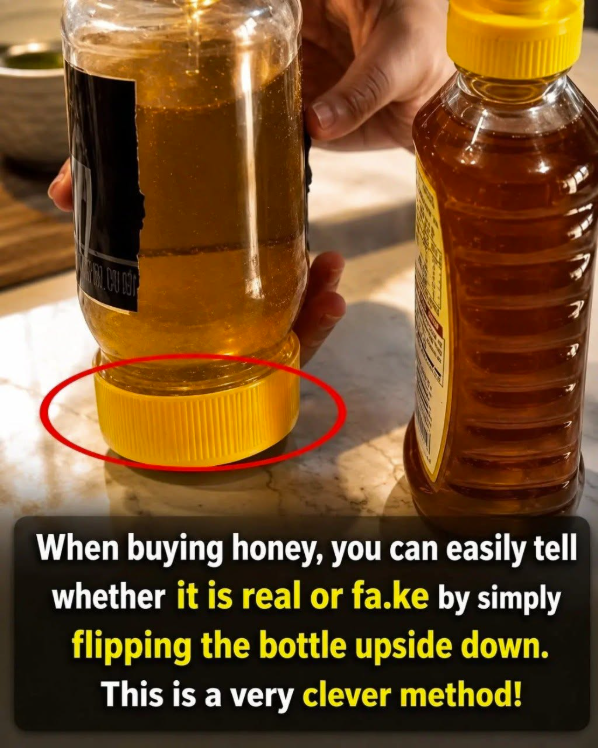
If you have ever stood in a grocery store comparing different jars of honey, you may have come across a popular trick: turn the bottle upside down and watch how the honey moves.
The viral image claims that this simple trick can tell you whether honey is “real” or “fake.” It certainly looks convincing. Thick honey may move slowly, while a thinner product can appear to run quickly toward the cap.
But there is an important catch: the upside-down bottle test cannot reliably prove whether honey is authentic.
Honey naturally varies in thickness, moisture content, temperature, floral source, and processing. Even genuine honey can flow differently from one jar to another. The National Honey Board specifically notes that common home tests based on thickness, water, bread, flames, or crystallization cannot reliably distinguish pure honey from adulterated honey.
So what can you actually learn from turning a honey bottle upside down?
The Viral Upside-Down Honey Test
The idea behind the trick is simple.
You take a bottle or jar of honey, close it securely, and turn it upside down. You then watch the air bubble or honey move through the container.
According to the viral claim, real honey should move slowly, while fake or diluted honey supposedly moves rapidly.
The reasoning sounds logical because honey is generally viscous and syrup-like.
However, viscosity alone does not tell you what is inside the bottle.
A genuine honey can become noticeably thinner when it is warm. Another genuine honey may naturally be thicker because of its composition, moisture level, or variety.
In other words:
Slow movement does not prove that honey is pure.
And:
Fast movement does not prove that honey is fake.
That's why this test is better considered a visual curiosity than an authenticity test.
Why Genuine Honey Can Have Different Thicknesses
One of the biggest reasons these viral tests are misleading is that not all real honey looks or behaves exactly the same way.
Honey comes from different floral sources, and its natural composition can vary.
Some honey is relatively fluid, while other varieties are naturally thick.
Temperature also matters enormously.
Honey generally becomes less viscous when warmed and thicker when cooled. A bottle sitting in a warm kitchen may therefore behave very differently from the same bottle stored in a cool cupboard.
This means two completely genuine bottles of honey can produce different results when you turn them upside down.
Crystallization Doesn't Mean the Honey Is Fake
Another common misconception is that genuine honey should always remain perfectly liquid.
That's not true.
Honey naturally crystallizes because some of its sugars, particularly glucose, can form crystals. The rate and appearance of crystallization vary between honey varieties.
You might therefore encounter:
- Clear liquid honey
- Cloudy honey
- Thick honey
- Creamy honey
- Partially crystallized honey
- Fully crystallized honey
These appearances alone don't establish whether honey is authentic.
In fact, the National Honey Board identifies the belief that crystallization proves honey is fake as another common home-testing myth.
Why Honey Authenticity Is Actually Difficult to Test at Home
There really is a reason people continue looking for easy honey tests.
Honey adulteration is a genuine food-fraud issue.
Less expensive sweeteners can be added to honey to reduce costs and increase profits. The U.S. Food and Drug Administration continues to monitor honey for this type of economically motivated adulteration. In its FY2025 testing program, the FDA tested 102 honey samples and identified four violative samples containing undeclared added sweeteners.
So the concern itself isn't imaginary.
The problem is that detecting adulteration isn't as simple as looking at how quickly honey moves inside a bottle.
Different adulterants can behave differently, and honey itself naturally varies.
Laboratory methods can analyze characteristics that aren't visible to the naked eye.
For example, the FDA's recent honey testing used stable carbon isotope ratio analysis and additional expert review to determine whether samples were consistent with authentic honey.
That is very different from simply turning a bottle upside down.
What About the Water Test?
You may have also seen another popular trick online.
Put a spoonful of honey into a glass of water.
The viral claim usually says that genuine honey will remain together or sink, while fake honey will immediately dissolve.
Again, this isn't a dependable authenticity test.
The National Honey Board explains that pure honey is naturally water-soluble, and it will dissolve in water. The speed at which it dissolves can also depend on factors such as temperature.
So if your honey dissolves in water, that doesn't automatically mean you've purchased fake honey.
What About the Thumb Test?
Another internet trick involves placing a drop of honey on your thumb.
The supposed rule is:
If the honey spreads, it's fake.
But this also fails to account for natural differences in honey viscosity.
Pure honey can have different thicknesses. A genuine variety that is relatively fluid may spread more easily than a thicker variety.
Consequently, the way a drop behaves on your thumb cannot establish authenticity.
What About the Flame or Match Test?
This is one of the more dangerous viral methods.
Some social-media posts suggest dipping a match or cotton wick into honey and attempting to light it. The claim is that pure honey supposedly burns while adulterated or diluted honey doesn't.
This is not a dependable way to identify authentic honey.
The amount of moisture naturally present in honey can vary, and that can affect whether a match or wick burns.
The National Honey Board specifically lists the flame test among the unreliable home tests for honey authenticity.
There is also little reason to introduce an open flame into a food-testing experiment when safer options exist.
So How Can You Make a Better Choice When Buying Honey?
Although you cannot prove authenticity simply by looking at the bottle, there are several practical things you can do when purchasing honey.
1. Read the Ingredient List
Start with the label.
If you're looking specifically for honey rather than a honey-flavored syrup or blend, check what the product actually contains.
Food labeling rules vary by country, but the basic principle is important: know what you're purchasing rather than relying on a viral visual test.
In the United States, for example, the FDA states that when other sweeteners are added to honey, the resulting product must be labeled as a blend rather than simply “honey,” with the added sweeteners declared in the ingredient statement.
2. Look at the Producer
Buying from a transparent producer can make it easier to learn where the honey came from.
Look for information about:
- Country or region of origin
- Producer or beekeeper
- Floral source, when provided
- Processing information
- Batch or lot information
- Contact information
None of these things alone proves authenticity, but they can provide useful context.
3. Don't Automatically Reject Crystallized Honey
If your honey has crystallized, don't assume something is wrong with it.
Crystallization is a natural process and different types of honey crystallize at different rates.
Some honey can become very thick or almost solid while remaining perfectly usable.
If you prefer liquid honey, gentle warming can return some crystallized honey to a more fluid consistency. Avoid excessive heating, particularly if preserving specific quality characteristics matters to you.
4. Be Skeptical of Extremely Simple “Proofs”
Social media loves tests that produce an immediate answer:
“Do this one thing and you'll know instantly.”
Food authenticity is rarely that simple.
A bottle turning slowly upside down can look impressive in a video, but appearance and viscosity aren't enough to identify adulteration.
The same applies to:
- Water tests
- Flame tests
- Bread tests
- Thumb tests
- Crystallization tests
These may be interesting demonstrations of honey's physical properties, but they aren't reliable authenticity tests.
The One Thing the Upside-Down Test Can Tell You
There is still something interesting about the trick.
Turning honey upside down can give you a rough visual impression of how fluid or viscous the product is under those particular conditions.
That's all.
It may help you notice that one honey is thicker than another.
But it cannot tell you with confidence whether the honey contains added syrup.
That's an important distinction.
Viscosity is a physical characteristic. Authenticity is a compositional question.
Those aren't the same thing.
Why the Viral Trick Seems So Convincing
There is a psychological reason these tests spread so easily.
The result is visible.
You flip the bottle, watch the honey move, and immediately get a dramatic-looking result. That makes the method feel scientific.
But a test isn't reliable simply because it produces a visible difference.
For an authenticity test to work, the result needs to consistently distinguish genuine products from adulterated ones while accounting for natural variation.
Honey is particularly complicated because its physical characteristics naturally vary.
That's why professional testing is much more sophisticated.
What Laboratory Testing Can Do
When regulators investigate suspected honey adulteration, they don't simply compare thickness.
The FDA's recent honey surveillance used analytical techniques capable of detecting certain undeclared sweeteners. The agency also notes that different adulterants can require different analytical approaches.
This is important because an apparently “real” bottle could still contain an adulterant that doesn't dramatically change its appearance or viscosity.
For consumers, this means there is no household trick that can guarantee authenticity.
If the authenticity of a particular product is genuinely important, laboratory analysis is the appropriate route rather than relying on social-media tests. The National Honey Board similarly states that laboratory testing is necessary for determining honey authenticity.
A Simple Honey-Buying Checklist
Next time you're shopping for honey, instead of relying entirely on the upside-down bottle trick, consider this checklist:
✔ Read the label
Make sure you understand what product you're buying.
✔ Check the ingredients
Look for whether the product is honey or a blend containing other sweeteners.
✔ Look for origin information
A clearly identified producer and source can provide useful transparency.
✔ Don't fear crystallization
Crystallized honey isn't automatically fake.
✔ Don't judge solely by thickness
Real honey can be thick or relatively fluid.
✔ Don't rely on viral home tests
Water, flame, bread, thumb, crystallization, and upside-down tests cannot reliably prove authenticity.
✔ Remember that laboratory analysis is different
Professional testing can examine the composition of honey in ways that simple household observations cannot.
Frequently Asked Questions
Does real honey move slowly when a bottle is upside down?
It can, but this isn't guaranteed. Honey's viscosity varies naturally with variety, moisture, and temperature.
Does fake honey move quickly?
Not necessarily. A fast-moving honey isn't automatically adulterated.
Does crystallized honey mean it is fake?
No. Crystallization is a natural process that occurs at different rates in different honey varieties.
Can the water test prove honey is real?
No. Genuine honey is water-soluble, so dissolving in water does not prove that it is fake.
Is the flame test accurate?
No. The flame test is another unreliable home test for honey authenticity.
Is honey adulteration a real problem?
Yes. Food-fraud authorities have detected honey containing undeclared added sweeteners, which is why regulatory testing continues.
The Bottom Line
The viral “flip the honey bottle upside down” trick is clever-looking, but it shouldn't be presented as a reliable way to determine whether honey is real or fake.
A slow-moving bottle doesn't prove purity, and a fast-moving bottle doesn't prove adulteration.
Honey naturally varies in thickness, and temperature can dramatically affect how it flows. Even crystallization, another commonly misunderstood characteristic, is a natural feature of many genuine honeys.
The bigger lesson is simple: don't confuse a visible physical property with a scientific authenticity test.
When buying honey, pay attention to the label, ingredients, producer, and origin information. And if you need genuine proof of authenticity, laboratory analysis—not an upside-down bottle—is the dependable approach.


0 comments:
Post a Comment