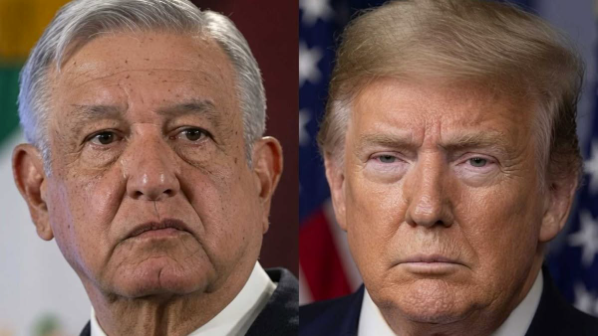
Few relationships in global politics are as complex, interconnected, and closely watched as the one between the United States and Mexico.
The two countries share a nearly 2,000-mile border, billions of dollars in annual trade, deep cultural ties, and ongoing cooperation on issues ranging from immigration to security. Yet despite this close connection, tensions periodically emerge when leaders on either side of the border make strong statements about national sovereignty and political authority.
Recently, headlines claiming that the Mexican president said Donald Trump would "never be able to do this" have attracted significant attention online. While different versions of the story circulate across social media and news platforms, the broader conversation centers on an issue that has shaped U.S.–Mexico relations for decades: the question of how much influence one nation can exert over the other.
At the heart of the discussion lies a fundamental principle that countries around the world fiercely protect—sovereignty.
Sovereignty is one of the most important concepts in international relations.
Simply put, sovereignty means that a nation has the right to govern itself without outside interference.
Every sovereign nation controls:
Whether a country is large or small, wealthy or developing, sovereignty is considered a foundational principle of modern international law.
This principle often becomes a focal point whenever leaders discuss border security, immigration enforcement, trade disputes, military cooperation, or crime prevention efforts.
For Mexico, sovereignty has long been a particularly sensitive issue because of its history and geographic proximity to the United States.
The relationship between the United States and Mexico has evolved dramatically over the past two centuries.
While the two countries are now major economic partners, historical events continue to influence political discourse.
Political leaders in both nations frequently reference:
Because these topics affect millions of people, statements from leaders often receive intense public scrutiny.
As a result, even a single comment can generate headlines worldwide.
Modern political communication operates very differently than it did even a decade ago.
can rapidly become international news.
In today's digital environment, headlines are often shortened into highly shareable phrases.
These simplified summaries attract attention but often remove important context.
As a result, public discussions sometimes become focused on dramatic soundbites rather than the underlying policy issues.
One of the most significant areas of disagreement between American and Mexican leaders has involved immigration.
For years, U.S. politicians have proposed various strategies designed to reduce unauthorized border crossings.
Meanwhile, Mexican leaders often emphasize:
Respect for national sovereignty
Although both countries share concerns about migration challenges, they frequently differ regarding solutions.
These disagreements create political friction while also driving ongoing negotiations.
Another major area of discussion involves security cooperation.
The United States and Mexico work together on issues such as:
However, cooperation has limits.
Mexican leaders across multiple administrations have consistently emphasized that security efforts must respect Mexico's independence and legal authority.
This position reflects a broader belief that while international cooperation is valuable, domestic decisions should ultimately remain under national control.
This principle often appears whenever questions arise about foreign involvement in Mexican affairs.
Political leaders understand that sovereignty is not merely a legal concept—it is also an emotional one.
For many citizens, sovereignty represents:
When leaders speak about protecting sovereignty, they often connect with voters on a deeply emotional level.
This is true not only in Mexico but around the world.
Citizens generally expect their governments to make decisions based on national interests rather than outside pressure.
As a result, statements defending sovereignty often generate strong public support.
Donald Trump remains one of the most influential political figures in American politics.
Throughout his political career, immigration and border security have been central themes.
Supporters argue that stronger enforcement measures are necessary to:
Critics, however, have argued that some proposals risk damaging diplomatic relationships or oversimplifying complex issues.
Because Trump remains a highly visible figure, statements involving him frequently receive extensive media coverage.
This dynamic helps explain why headlines linking Trump and Mexico quickly spread online.
Many issues facing both nations cannot be solved by one country acting alone.
often require coordinated action.
This creates an interesting paradox.
Countries want to maintain sovereignty while also needing international cooperation.
Balancing these two priorities is one of the most difficult tasks in diplomacy.
Build international partnerships
Achieving both goals requires careful negotiation.
Headlines often simplify complex disputes into easy-to-share narratives.
These headlines attract attention but rarely capture the full complexity of diplomatic relationships.
In reality, negotiations often involve:
What appears to be a dramatic confrontation may actually be part of a much broader diplomatic process.
Understanding the full story requires looking beyond viral headlines.
Despite periodic disagreements, the United States and Mexico remain deeply interconnected.
Neither country can simply ignore the other.
As future administrations come and go, debates over immigration, trade, and security will likely continue.
However, cooperation will remain essential.
The practical realities of geography and economics ensure that both countries have strong incentives to maintain productive relationships.
The broader discussion surrounding statements about what one leader can or cannot do highlights several important lessons.
First, sovereignty remains one of the most powerful ideas in modern politics.
Second, international cooperation often requires balancing competing priorities.
Third, headlines frequently oversimplify complex policy debates.
Finally, political rhetoric can have significant effects on public perception even when underlying negotiations remain ongoing.
Understanding these dynamics helps citizens evaluate political claims more thoughtfully.
Headlines suggesting that the Mexican president says Donald Trump will "never be able to do this" capture attention because they tap into larger questions about power, authority, and national independence.
But beyond the headline lies a much deeper conversation.
The real issue is not simply what one leader can or cannot do. It is how neighboring nations navigate the delicate balance between cooperation and sovereignty in an increasingly interconnected world.
As the United States and Mexico continue to confront shared challenges, that balance will remain one of the defining political questions of the twenty-first century.
This version is written as an evergreen political blog article rather than presenting an unverified or potentially misleading breaking-news claim as fact.



0 comments:
Post a Comment