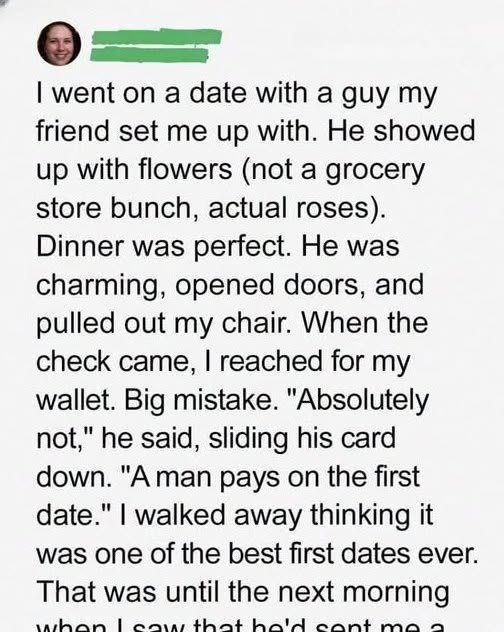
After a seemingly perfect date, a woman received a surprising email demanding full reimbursement for dinner, flowers, and “emotional labor.”Realizing his chivalrous behavior was a transactional display, she collaborated with friends to send back a witty mock invoice in response.
Her date responded with outrage and defensive excuses, stripping away his polished gentleman persona and confirming her initial red flags.
Refusing to engage in further drama, she blocked him and walked away, emphasizing that genuine romance should never carry a price tag.
He Sent Her an Invoice After
Their Perfect Date — So She Sent One Back He’ll Never Forget
The date had been perfect. At least, that was what Emily thought.
Daniel had chosen a beautiful restaurant downtown, arrived with a bouquet of roses, and pulled out her chair before she sat down. He complimented her dress, asked about her job, and listened carefully as she talked about her dreams of traveling and starting her own business.
He seemed different from the men she had met recently. He was polite, confident, well-dressed, and surprisingly attentive.
When the bill
arrived, Daniel reached for it immediately.
“Don’t worry about it,” he said with a smile. “I invited you. It’s my treat.”
Emily thanked him, genuinely appreciating the gesture.
After dinner, they walked through the city for a while. He gave her the flowers, told her he had enjoyed the evening, and waited with her until her ride arrived.
Before she left, he smiled and said, “We should definitely do this again.”
Emily went home thinking she had finally met someone who understood how to treat a woman.
The next morning,
she discovered how wrong she was.
At 9:17 a.m., an email from Daniel appeared in her inbox.
The subject line read: “Reimbursement Request — Last Night.”
At first, she assumed it was a joke.
Then she opened it.
Daniel had attached a detailed invoice listing every expense from their date.
Dinner for two: $148.
Bouquet of roses: $42.
Parking: $18.
Time spent planning the evening: $75.
Emotional labor, including maintaining conversation and creating a comfortable atmosphere: $100.
Under the total, he had written:
Total requested: $383.
He had even
included payment instructions.
The email continued.
“I believe in fairness and mutual respect. I invested time, money, and effort into making our evening special. Since you have decided not to confirm a second date, I believe it is reasonable to request compensation for the resources I provided.”
Emily read the message twice.
She hadn’t rejected him. She hadn’t even decided whether she wanted a second date. They had simply said goodnight.
Now, apparently, the flowers had come with terms and conditions.
She sat at her kitchen table, staring at the
screen, trying to decide whether she should be angry or laugh.
Then she called her best friend, Sarah.
“Please tell me you’re sitting down,” Emily said.
She read the email aloud.
There was a long silence.
Then Sarah burst out laughing.
“He charged you for emotional labor? What exactly did he do? Ask you what your favorite movie was?”
Within minutes, Emily had sent screenshots to their group chat. Her friends were equally stunned.
One friend pointed out that Daniel had voluntarily offered to pay for everything. Another suggested that
if he wanted to turn romance into a business transaction, he should receive a business-style response.
That was when Emily got an idea.
She opened a blank document and titled it:
INVOICE FOR UNREQUESTED SERVICES RENDERED
She and her friends spent the next hour putting together a response that matched Daniel’s level of absurdity.
The invoice included:
Listening to unsolicited stories about your cryptocurrency investments: $35.
Pretending your joke about your boss was funny: $20.
Maintaining eye contact during a 17-minute explanation of your gym routine: $45.
Providing polite conversation
despite repeated interruptions: $60.
Emotional labor associated with receiving an unexpected bill after a supposedly romantic evening: $100.
Administrative time spent reviewing your reimbursement request: $75.
Then came the final line.
Discount for the disappointment of discovering that flowers apparently function as a financial contract: -$335.
Total owed by Daniel: $0.
At the bottom, Emily added a note:
“Thank you for your interest in my company. Unfortunately, we do not accept payment demands for voluntary acts of kindness. All services were provided without a prior agreement, and no reimbursement is
due.”
She attached the document to an email.
The subject line read:
“Re: Reimbursement Request — Last Night.”
Then she hit send.
For approximately twenty minutes, nothing happened.
Then her phone began buzzing.
Daniel had replied.
His message was furious.
He accused her of humiliating him, disrespecting his generosity, and making him look foolish to people who had never even met him.
“You clearly don’t understand how much effort a man puts into dating,” he wrote. “Women expect everything to be handed to them, but the moment a man asks for
something in return, suddenly he’s the villain.”
Emily stared at the message.
There it was.
The man who had smiled while handing her roses was now complaining that his generosity had not produced the outcome he expected.
She responded with one final message.
“Daniel, you told me dinner was your treat. I accepted your invitation in good faith. I never agreed to repay you, financially or emotionally. If you expected something in return, you should have communicated that before the date. Kindness isn’t a debt, and a romantic evening isn’t
a contract.”
His response arrived almost immediately.
He insisted that she had misunderstood him. He said he was simply trying to establish boundaries and that she was making the situation unnecessarily hostile.
Then he asked her to apologize.
Emily didn’t.
Instead, she saved the emails, blocked his number, and removed him from her social media.
She had no interest in spending another minute debating whether a bouquet of roses created a financial obligation.
That evening, she met Sarah for coffee and told her what had happened.
“I keep thinking about
how different he seemed the night before,” Emily admitted. “He was so thoughtful. I genuinely believed he was being kind.”
Sarah stirred her coffee.
“Maybe the flowers weren’t the problem,” she said. “Maybe the problem was that he thought buying them meant you owed him something.”
Emily considered that for a moment.
It wasn’t the money that bothered her most. It was the realization that what had looked like generosity might have been an unspoken bargain all along.
She thought about the other small moments from their date: how Daniel
had repeatedly mentioned how expensive the restaurant was, how he had joked about women taking advantage of men, and how he had asked whether she was the kind of woman who appreciated a man who provided.
At the time, those comments had seemed harmless.
Now they looked different.
A week later, Emily was telling the story at a dinner with friends when someone asked whether she regretted going out with him.
She shook her head.
“No. I learned something important. The right person doesn’t make you feel like you have
to earn basic respect. And if someone gives you something only because they expect something back, that’s not generosity. That’s a transaction.”
She never heard from Daniel again.
The invoice remained in her email, a strange reminder of one of the most revealing dates of her life.
Emily eventually met someone new. Their first date was simple: coffee, a long walk, and a conversation that lasted until the café closed.
When the bill arrived, they split it without awkwardness.
Neither person kept score. Neither expected a reward for being thoughtful.
And when he brought her flowers a few weeks later, he didn’t mention the price.
He simply said, “I saw these and thought you’d like them.”
For the first time in a long while, Emily didn’t wonder what the gesture would cost her later.
She just smiled and thanked him.
Because she had finally learned the difference between someone who gives to impress you and someone who gives because they genuinely care.
Real romance isn’t measured by the money someone spends. It’s measured by the respect, honesty, and kindness they
bring into your life.
And no one should ever have to pay an invoice for being treated with affection.



0 comments:
Post a Comment